Why External Attack Surface Monitoring Is the Highest-ROI Security Investment You’re Probably Not Making
24 December 2025 · 4 min read
On this page
- The hidden cost of not seeing yourself the way attackers do
- What modern External Attack Surface Monitoring actually means
- The six exposure layers attackers exploit first
- Why External Attack Surface Monitoring delivers outsized ROI
- Why point-in-time scans fail (and attackers know it)
- From dashboards to decisions: where AI changes the game
- The bottom line
Most cyberattacks don’t begin with malware.
They begin with visibility.
An attacker doesn’t brute-force your firewall. They Google you.
They map your domains.
They scrape LinkedIn.
They check leaked credentials.
They look for the one forgotten asset no one owns anymore.
That collection of exposed, unmanaged, and often unknown assets is your external attack surface-and for most organisations, it’s growing faster than security teams can track.
This is why External Attack Surface Monitoring (EASM) has quietly become one of the highest-ROI security controls for modern businesses.
The hidden cost of not seeing yourself the way attackers do
According to industry data, the average cost of a breach for SMBs and mid-market companies in India is ~₹1.8 Cr
And over 62% of breaches now originate through third parties or external exposures, not internal systems.
Yet most organisations still rely on:
- Periodic audits
- Point-in-time vulnerability scans
- Manual asset inventories
- Spreadsheets and screenshots for evidence
The result?
- Alert overload
- Tool sprawl (5 -15 tools per organisation)
- Missed exposures
- Slow response
- High compliance penalties (₹50 - 250 Cr for regulated entities)
Security teams are overloaded - while attackers are automated.
What modern External Attack Surface Monitoring actually means
True EASM is not just “outside-in scanning.”
It is continuous discovery, validation, correlation, and prioritisation of everything the internet can see - and misuse - about your organisation.
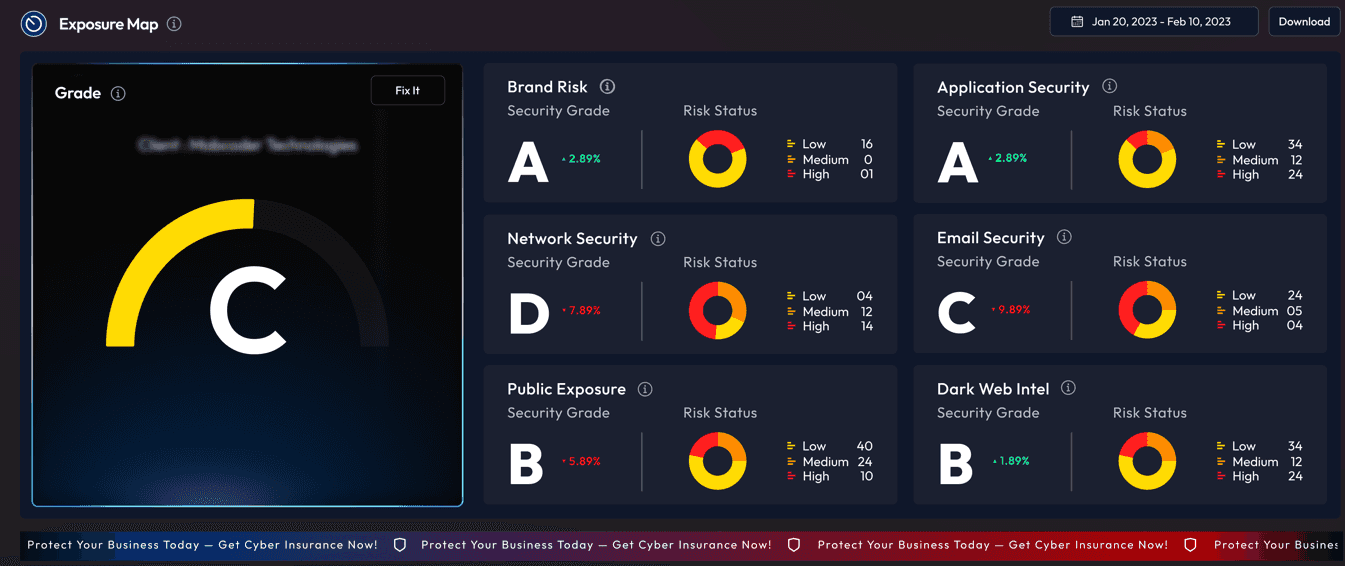
NMT Security’s External Attack Surface Monitoring capability, built into its NOVA | AI CISO platform, scans:
- 700+ attack vectors
- 100+ security checks
- Across 6 critical exposure categories
All without agents. All continuously.
The six exposure layers attackers exploit first
1. Brand Risk Monitoring
Your brand is an attack surface.
NOVA identifies:
- Impersonating and lookalike domains
- Typosquatting attempts
- Fake login pages
- Brand abuse used in phishing and fraud
Why it matters:
Customers don’t differentiate between you and someone pretending to be you. Fraud equals reputational damage.
2. Application Security
Attackers don’t care how well your code is written - only whether it’s reachable.
The platform detects:
- Exposed APIs
- Debug endpoints
- Missing security headers
- Technology and version leakage
This is real-world exploitability, not theoretical vulnerability scoring.
3. Network Security
Old ports never die - they just get exploited.
NOVA continuously monitors:
- Open RDP, SSH, database ports
- Misconfigured cloud firewalls
- Legacy services tied to forgotten infrastructure
These are the entry points ransomware groups love most.
4. Public Exposure
Most leaks are accidental, not malicious.
The platform detects:
- Public storage buckets
- Exposed backups
- Configuration files
- Hardcoded secrets and tokens
One exposed .env file can collapse years of internal security controls.
5. Email Security
Email remains the #1 attack vector.
NOVA evaluates:
- SPF, DKIM, DMARC posture
- Spoofing feasibility
- Business Email Compromise (BEC) risk
Weak email configuration = impersonation at scale.
6. Dark Web Intelligence
This is where exposure becomes evidence.
The platform correlates findings with:
- Leaked credentials
- Data dumps
- Access broker listings
- Underground chatter referencing your organisation
This tells you what’s already being exploited, not just what could be.
Why External Attack Surface Monitoring delivers outsized ROI
Unlike traditional tools that add more alerts, EASM reduces cost by removing attack paths early.
Organisations using NOVA’s External Exposure capabilities have reported outcomes such as:
- 40-60% reduction in tool costs
- 70% faster compliance readiness
- 90% fewer false positives
- 40-50% reduction in manual security work
- Continuous DPDP, RBI, and SEBI readiness
In one case, one of India's largest NBFC enabled Risk Registry + External Exposure + TPCRM automation within the first 30 days
That’s not just security improvement - that’s operational efficiency.
Why point-in-time scans fail (and attackers know it)
Your attack surface changes when:
- A new domain is registered
- A marketing campaign goes live
- A SaaS tool is adopted
- An employee joins or leaves
- A cloud asset is spun up “temporarily”
Attackers monitor continuously.
Security assessments usually don’t.
External Attack Surface Monitoring only works when it’s always on.
From dashboards to decisions: where AI changes the game
NOVA is not just a scanner.
It acts as a 24×7 AI CISO that:
- Correlates external exposure with compliance impact
- Prioritises risks based on exploitability and business context
- Validates evidence automatically
- Maintains an audit-ready risk registry
This is what turns raw exposure data into board-level decisions.
The bottom line
You can invest endlessly in internal controls - SOCs, SIEMs, EDRs, IAM - and still lose the game if your external attack surface is unmanaged.
Attackers don’t knock.
They walk through the door you didn’t know was open.
External Attack Surface Monitoring delivers ROI not by detecting breaches faster - but by preventing them from happening at all.
And in cybersecurity, prevention isn’t just cheaper.
It’s reputation-saving, compliance-preserving, and business-critical.
More from the blog
See all articles
5 min read
Compliance Is the Baseline. Risk Is the Real Question.
For years, cybersecurity compliance was largely treated as a security function. Policies were documented, controls were tested, evidence was collected and audits were…

6 min read
Compliance Has Stages. The Risk Does Not Wait.
What does compliance really protect you from? The FICCI-EY Risk Survey 2026 found that 61% of respondents identified cyberattacks and data breaches as major financial…

7 min read
Cybersecurity Tool Sprawl: More Detection, Less Direction
There is a point in every organisation's security journey where adding another tool stops solving a security problem and starts creating one. A new endpoint threat leads…

See what Foresee finds on your own domain.
A 30-minute call. Share a domain and we will walk you through what we find.