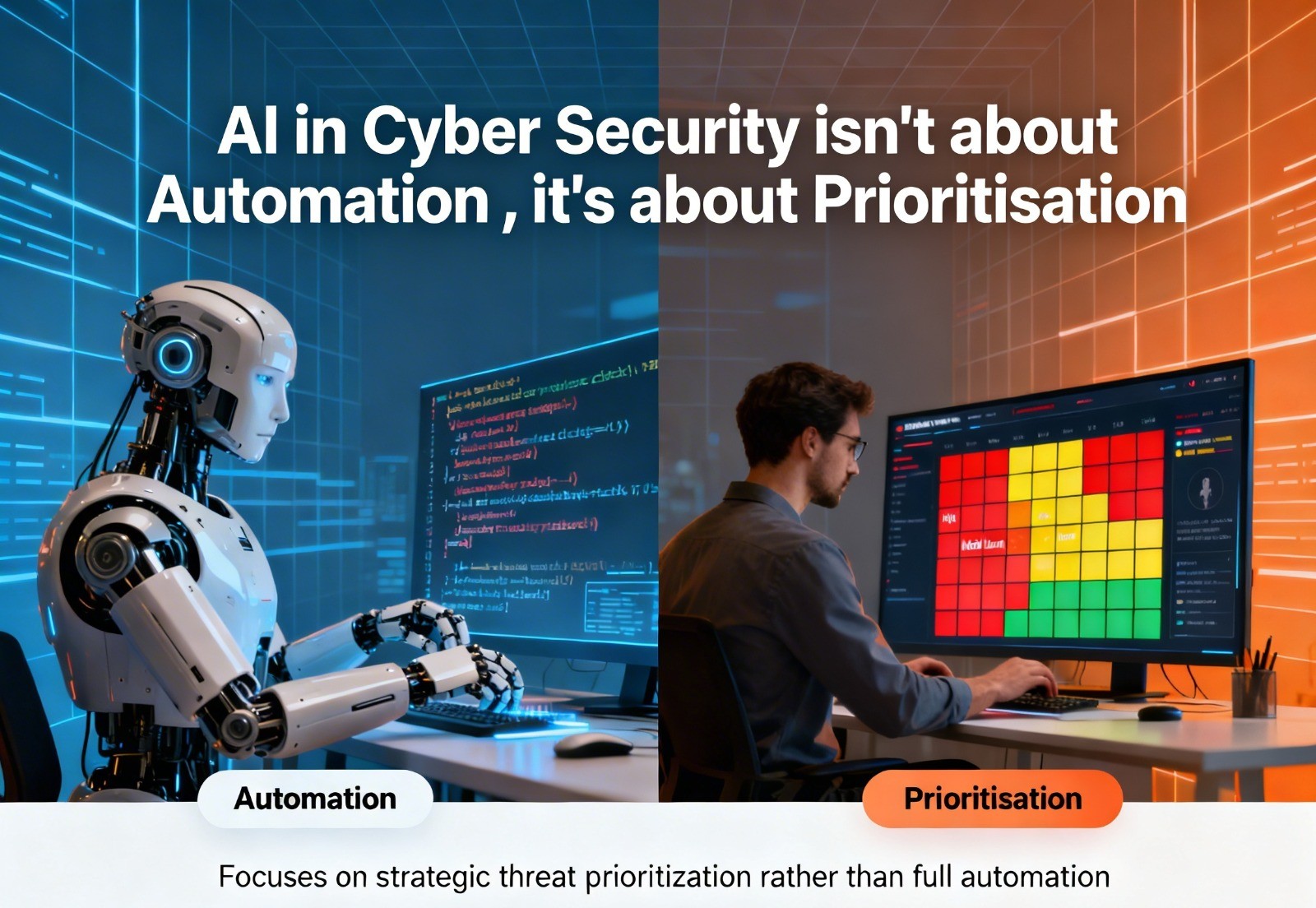
AI in Cybersecurity Isn’t About Automation, It’s About Prioritisation
11 March 2026 · 4 min read
On this page
Artificial intelligence is rapidly becoming embedded in cybersecurity platforms. Automation now drives vulnerability scanning, log analysis, alert generation, ticket creation, and compliance reporting across most enterprise environments.
Yet despite these advances, security teams remain overwhelmed. Alert volumes continue to grow, operational fatigue persists, and measurable risk reduction often lags behind rising security investment.
This disconnect highlights an important reality: automation alone does not improve security outcomes.
What organizations increasingly need is not faster task execution, but better prioritisation of risk.
Automation Has Solved the Operational Problem
Automation has significantly improved operational efficiency. Routine tasks that once required hours of manual analysis can now be executed automatically. Vulnerabilities are scanned continuously, alerts are generated in real time, and remediation tickets are created automatically.
However, automation primarily addresses how fast tasks are completed, not which tasks actually matter.
In many environments, automation accelerates the production of alerts without improving the clarity of decision-making. Security teams may close hundreds of tickets while critical exposures remain unresolved.
Resolving ten low-impact issues does not reduce meaningful risk if a single high-impact exposure remains active.
Automation increases activity.
It does not necessarily improve outcomes.
The Expanding Signal Problem
Modern enterprises operate highly distributed digital environments that generate security signals from multiple domains:
- Vulnerability management systems
- Cloud security posture platforms
- Identity and access management tools
- External attack surface monitoring solutions
- Third-party risk management platforms
- Compliance and governance frameworks
Each of these tools contributes valuable insights, but when evaluated independently they produce fragmented risk signals.
Security teams must reconcile hundreds or thousands of alerts daily, many of which appear equally urgent due to standardized severity scoring.
Without contextual prioritisation, organizations risk allocating resources toward issues that are technically severe but operationally insignificant, while overlooking exposures that could materially affect the business.
Why Prioritisation Is the Real Challenge
The most critical question security leaders face is not whether vulnerabilities exist, but which vulnerabilities present the greatest business risk.
Effective prioritisation requires understanding multiple contextual factors simultaneously, including:
- Asset criticality
- External exposure
- Exploitability
- Identity and access pathways
- Third-party dependencies
- Regulatory or compliance implications
Only when these dimensions are evaluated together can organizations determine which risks require immediate attention.
This is where AI can deliver meaningful value.
The Role of AI in Risk Prioritisation
Artificial intelligence should not be viewed solely as a tool for accelerating workflows. Its greater potential lies in synthesizing diverse security signals and identifying the issues most likely to cause material harm.
AI-driven prioritisation enables organizations to correlate information such as:
- External exposure of assets
- Vulnerability exploitability and attack likelihood
- Identity privileges and access paths
- Vendor or supply-chain dependencies
- Compliance obligations tied to specific systems
By integrating these factors, AI can help security teams move beyond raw alert counts toward a ranked view of enterprise risk.
The result is not more alerts, but better decision support.
Industry Examples: Where Prioritisation Matters Most
The importance of prioritisation becomes particularly clear when viewed through the lens of different industries.
Financial Services (BFSI and NBFC)
In financial services, a moderate vulnerability affecting an internal test system may have limited impact. However, a similar vulnerability affecting a payment API or digital banking interface could expose the organization to fraud, regulatory penalties, and customer trust erosion.
Effective prioritisation ensures that security teams focus on risks affecting financial transactions and identity systems first.
Healthcare
Healthcare organizations manage systems that directly influence patient care and regulatory compliance. A configuration issue affecting a clinical system or patient data platform carries significantly greater risk than isolated infrastructure vulnerabilities.
AI-driven prioritisation can help ensure that risks impacting clinical availability and patient data protection are addressed immediately.
Manufacturing
Manufacturing environments increasingly rely on interconnected IT and operational technology (OT) systems. Vulnerabilities affecting production control systems may disrupt manufacturing lines, supply chains, and contractual commitments.
Prioritisation helps security teams differentiate between general IT exposures and those capable of halting operational processes.
Retail and E-commerce
Retail organizations operate customer-facing digital platforms and payment systems where availability and trust are critical. Security teams must prioritize exposures affecting customer data, payment infrastructure, and peak transaction environments.
Addressing these risks first protects both revenue and brand reputation.
Technology and SaaS
Technology providers and SaaS platforms rely heavily on uptime, identity infrastructure, and secure customer environments. A single exposed service or compromised credential can affect thousands of downstream users.
Prioritisation ensures that risks affecting availability, identity layers, and multi-tenant environments receive immediate attention.
From Activity to Impact
Automation has already transformed how cybersecurity tasks are performed. The next stage of maturity will focus on how security decisions are made.
Organizations that prioritize effectively can:
- Reduce exposure faster
- Allocate resources more efficiently
- Improve executive confidence in security programs
- Demonstrate measurable reductions in enterprise risk
In contrast, organizations that focus solely on automation may achieve operational efficiency while leaving meaningful exposures unresolved.
The Future of Cybersecurity
The evolution of cybersecurity will increasingly depend on decision intelligence rather than operational automation.
Automation improves efficiency.
Prioritisation improves outcomes.
Artificial intelligence will play its most valuable role not by generating more alerts, but by helping organizations determine which risks truly matter.
Final Perspective
Security teams do not lack data. They lack clarity on what to address first.
The organizations that succeed in the next phase of cybersecurity will be those that move beyond automation and adopt AI-driven prioritisation as the foundation of risk management.
The question for security leaders is simple:
Where in your security program does automation still create activity but not clarity?
More from the blog
See all articles
5 min read
Compliance Is the Baseline. Risk Is the Real Question.
For years, cybersecurity compliance was largely treated as a security function. Policies were documented, controls were tested, evidence was collected and audits were…

6 min read
Compliance Has Stages. The Risk Does Not Wait.
What does compliance really protect you from? The FICCI-EY Risk Survey 2026 found that 61% of respondents identified cyberattacks and data breaches as major financial…

7 min read
Cybersecurity Tool Sprawl: More Detection, Less Direction
There is a point in every organisation's security journey where adding another tool stops solving a security problem and starts creating one. A new endpoint threat leads…

See what Foresee finds on your own domain.
A 30-minute call. Share a domain and we will walk you through what we find.