DPDP Rules 2025 - What You MUST Do Right Now
15 November 2025 · 3 min read
On this page
- DPDP Rules, 2025 — Detailed Enforcement Timeline & What It Means for Indian Businesses
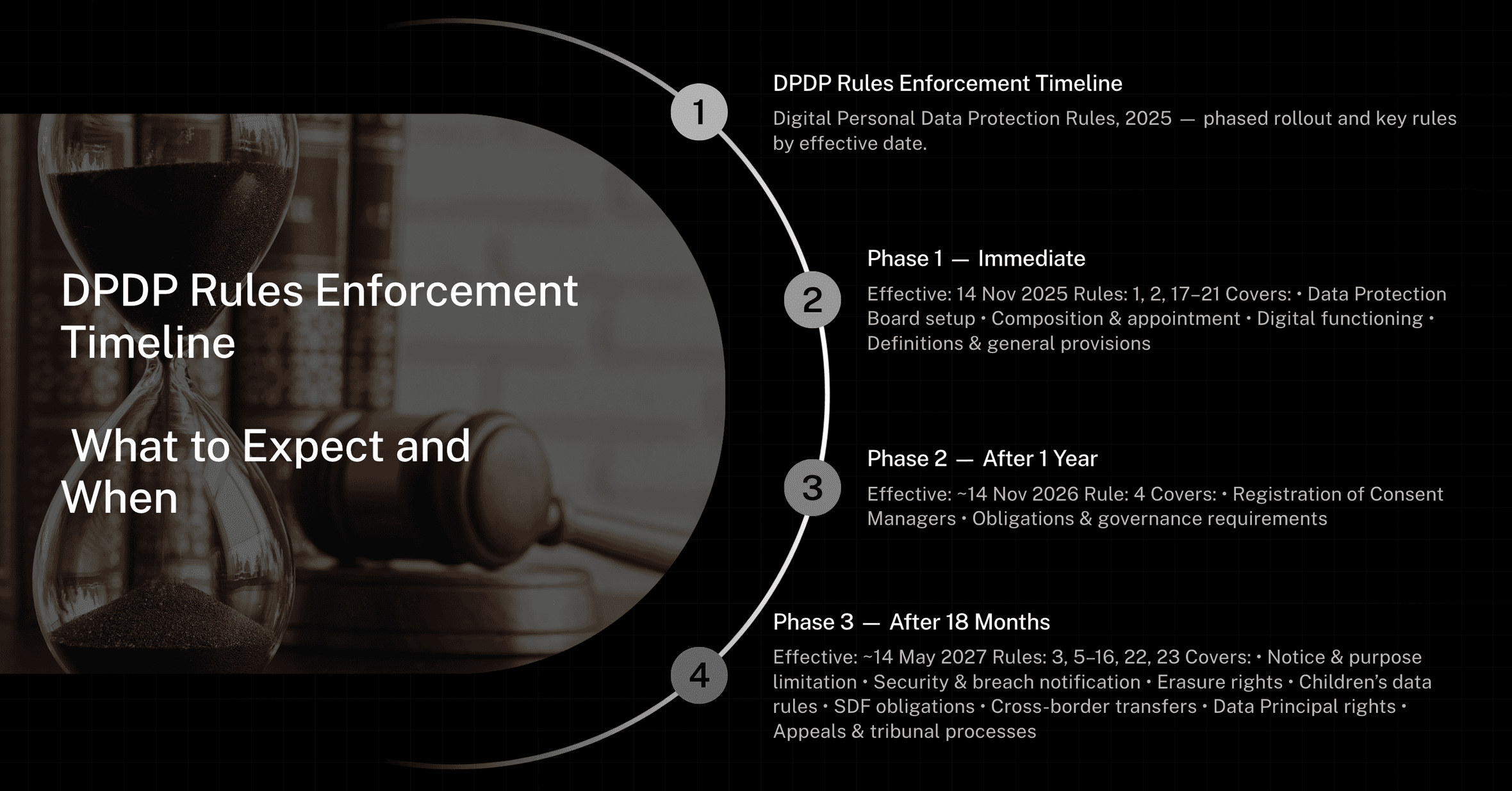
- Phase 1 - Immediate Enforcement (14 November 2025)
- Phase 2 - One Year After Notification (Approx. 14 November 2026)
- Phase 3 - Eighteen Months After Notification (Approx. 14 May 2027)
- What This Means for Businesses Today
- Even though core obligations activate in 2027, the preparation must begin now.
- How Companies Can Start Preparing (Practical Steps)
- Conclusion
DPDP Rules, 2025 — Detailed Enforcement Timeline & What It Means for Indian Businesses
India has officially entered the next phase of its digital governance journey with the notification of the Digital Personal Data Protection Rules, 2025. These Rules operationalise the Digital Personal Data Protection Act (DPDPA), and together, they form the most comprehensive data protection framework India has ever implemented.
Importantly, the Government has chosen a phased enforcement model, balancing regulatory expectations with the practical realities of implementation. This approach ensures organisations—from startups to large enterprises—have the necessary window to strengthen internal processes, upgrade systems, and build compliance readiness.
Below is a verified breakdown of the phases, supported by the official Gazette notification and validated industry sources.
Phase 1 - Immediate Enforcement (14 November 2025)
These sections form the structural backbone of the law. They came into force immediately upon notification and cover:
- Formation of the Data Protection Board of India
- Appointment criteria, functioning guidelines, and procedures
- Definitions and general provisions
- Short title and commencement clarifications
- Digital workflows and official processes
Essentially, Phase 1 activates the infrastructure needed to enforce the rest of the law.
Phase 2 - One Year After Notification (Approx. 14 November 2026)
Rule 4 formalises the requirements for Consent Managers, a unique and important concept under India’s DPDP regime. This phase includes:
- Registration process for Consent Managers
- Compliance criteria and reporting obligations
- Standards for interoperability
- Duties and operational guardrails
The one-year buffer ensures that the Consent Manager ecosystem matures before becoming accountable under DPDP.
Phase 3 - Eighteen Months After Notification (Approx. 14 May 2027)
This is the most impactful phase for businesses and will require substantial preparation. It covers the operational, procedural, and technical obligations for all Data Fiduciaries, including:
- Data Fiduciary Obligations
- Lawful processing & valid notice
- Purpose limitation
- Security safeguards
- Breach notification timelines
- Erasure and correction workflows
- Duties specific to Significant Data Fiduciaries
- Rights of Data Principals
- Access rights
- Correction and erasure
- Grievance redressal
- Withdrawal of consent
- Special Category Considerations
- Children’s data
- Guardianship provisions
- Data of persons with disability
- Cross-Border Data Transfers
- Permitted countries
- Restrictions and safeguards
- Appeal Process
- Procedures for approaching the Appellate Tribunal
- Review timelines
- Escalation mechanics
By May 2027, organisations will be required to demonstrate end-to-end compliance across technology, process, governance, and documentation.
What This Means for Businesses Today
Even though core obligations activate in 2027, the preparation must begin now.
DPDP Compliance Is Not a Plug–and–Play Function
It requires building systems for:
- Data discovery & mapping
- Consent management
- Rights fulfilment workflows
- Vendor risk assessment
- Breach response playbooks
- Encryption & security controls
- Evidence-based governance
Non-compliance can lead to significant penalties
- The DPDP Act enables penalties up to ₹250 crore per violation category, making compliance a board-level priority.
Customers, investors, and regulators expect readiness.
- Enterprises, NBFCs, and fintechs are already demanding DPDP-aligned controls in vendor assessments.
How Companies Can Start Preparing (Practical Steps)
Step 1: Data Mapping & Inventory
Identify what personal data you collect, store, process, or share.
Step 2: Policy & Notice Updates
Privacy policies, consent notices, and retention statements must align with the upcoming obligations.
Step 3: Build Consent & Rights Management Processes
Plan the workflows - manual or automated - to support erasure, correction, withdrawal, and access requests.
Step 4: Strengthen Security Controls
Deploy foundational safeguards:
- Encryption
- Access controls
- Vulnerability management
- EDR/AV
- Backup and recovery
- Logging and monitoring
Step 5: Vendor & Third-Party Risk Governance
DPDP creates liability for vendors - ensure contracts, assessments, and monitoring are aligned.
Step 6: Prepare for Breach Reporting
DPDP mandates timely breach intimation; organisations must build detection-to-disclosure workflows.
Conclusion
The DPDP Rules, 2025 represent a landmark shift in India’s data protection landscape. The Government has structured enforcement sensibly - Immediate → 1 Year → 18 Months—to allow organisations to adapt. However, compliance is not optional and cannot be left to the last minute.
Early movers will not only meet regulatory expectations but also strengthen digital trust - critical for financial services, fintech, SaaS, e-commerce, and any business handling consumer data.
Schedule a Free 30-minute session to know more. Book Now.
More from the blog
See all articles
5 min read
Compliance Is the Baseline. Risk Is the Real Question.
For years, cybersecurity compliance was largely treated as a security function. Policies were documented, controls were tested, evidence was collected and audits were…

6 min read
Compliance Has Stages. The Risk Does Not Wait.
What does compliance really protect you from? The FICCI-EY Risk Survey 2026 found that 61% of respondents identified cyberattacks and data breaches as major financial…

7 min read
Cybersecurity Tool Sprawl: More Detection, Less Direction
There is a point in every organisation's security journey where adding another tool stops solving a security problem and starts creating one. A new endpoint threat leads…

See what Foresee finds on your own domain.
A 30-minute call. Share a domain and we will walk you through what we find.