Compliance Scores vs Real Risk Scores; Why They Are Not the Same
9 April 2026 · 3 min read
On this page
In many organizations, a strong compliance score brings reassurance. Dashboards show green indicators, controls are documented, and audit evidence is readily available. At first glance, this creates a sense of confidence that the security posture is sound.
However, compliance comfort should not be mistaken for actual security.
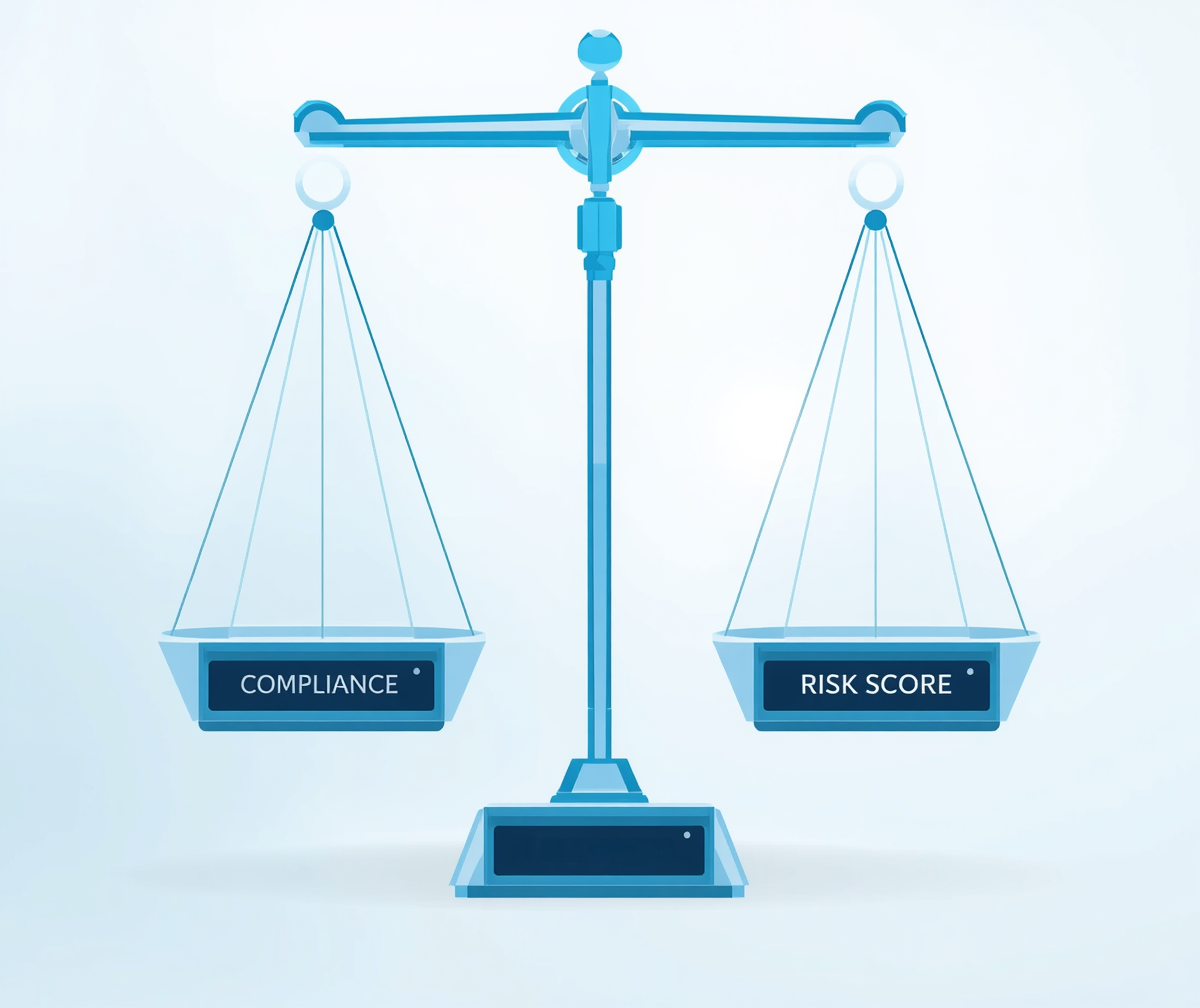
Compliance scores and real risk scores measure fundamentally different things. One demonstrates that governance processes are in place. The other evaluates the likelihood and potential impact of real-world cyber threats.
Understanding this distinction is critical for building mature security programs.
What Compliance Scores Actually Measure
Compliance frameworks such as ISO 27001, SOC 2, PCI-DSS, HIPAA, and others are designed to establish consistent security governance. They help organizations demonstrate that appropriate policies, procedures, and controls exist.
Compliance scoring typically evaluates whether:
- Required security controls are implemented
- Policies and procedures are documented
- Evidence of control execution is available
- Regulatory or framework obligations are satisfied
These scores are essential for demonstrating due diligence to regulators, partners, and auditors. In sectors such as BFSI and NBFC, compliance alignment is often mandatory for regulatory approval. In healthcare, frameworks ensure patient data protection. In technology and SaaS, compliance certifications are frequently prerequisites for enterprise customer trust.
Compliance scores therefore provide a valuable baseline for governance.
But they do not measure the actual likelihood of a breach.
What Real Risk Scores Measure
Real risk scoring focuses on exposure and exploitability rather than documentation.
A risk score considers factors such as:
- External exposure of systems and assets
- Vulnerability exploitability and attacker activity
- Asset criticality to business operations
- Identity and access pathways
- Third-party dependencies and supply chain exposure
These indicators reflect how attackers view the organization’s environment.
For example, a company may have well-documented security policies while still exposing public services with exploitable vulnerabilities. A compliant organization may also rely heavily on third-party integrations that introduce new attack paths.
In these situations, compliance status remains strong, but actual risk exposure may be significantly higher.
Industry Examples: When Compliance Does Not Equal Safety
The difference between compliance and real risk becomes clearer when viewed across industries.
Financial Services (BFSI and NBFC)
Financial institutions often maintain rigorous compliance frameworks due to regulatory oversight. Yet incidents can still occur if exposed APIs, identity vulnerabilities, or third-party fintech integrations introduce exploitable pathways.
Compliance may confirm that policies exist. Risk scoring evaluates whether attackers can exploit operational systems.
Healthcare
Healthcare providers frequently demonstrate compliance with strict patient data protection regulations. However, clinical systems, connected medical devices, or externally exposed cloud environments may introduce operational vulnerabilities.
Compliance frameworks confirm data governance. Risk scoring identifies systems that could disrupt patient care.
Manufacturing
Manufacturing environments often meet regulatory and operational compliance standards. Yet vulnerabilities affecting operational technology systems or supply chain integrations may expose production infrastructure.
Compliance ensures process adherence. Risk scoring highlights exposures capable of interrupting manufacturing operations.
Retail and E-commerce
Retail organizations may maintain strong compliance with payment and data protection standards. However, customer-facing applications, payment APIs, and third-party logistics integrations create dynamic attack surfaces.
Compliance demonstrates policy alignment. Risk scoring identifies exposure affecting revenue and customer trust.
Technology and SaaS
Technology companies often maintain multiple certifications to meet customer requirements. However, cloud misconfigurations, identity exposures, or publicly accessible development environments can introduce real-world risk.
Compliance validates governance maturity. Risk scoring reflects actual attack potential.
Why Confusing the Two Is Risky
Compliance answers the question:
“Are the required controls documented and implemented?”
Risk scoring answers a different question:
“What could go wrong next, and how likely is it?”
When organizations rely exclusively on compliance metrics, they risk overlooking exposures that attackers can exploit. Security teams may focus on audit readiness while overlooking real-world attack paths.
This disconnect can create a false sense of security.
The Role of Both Metrics in Mature Security Programs
Compliance and risk scoring are not competing approaches. They serve complementary roles.
Compliance frameworks provide governance structure and demonstrate accountability. Risk scoring provides operational intelligence for prioritizing security decisions.
Mature organizations therefore treat:
- Compliance as the baseline for governance and regulatory assurance
- Risk scoring as the engine for prioritizing protection and reducing exposure
One proves diligence.
The other drives protection.
Both are necessary for resilient cybersecurity programs.
Final Perspective
In modern digital environments, security cannot rely solely on documented controls. Attack surfaces evolve rapidly, third-party ecosystems expand, and exposure changes continuously.
Organizations that distinguish between compliance scores and real risk scores gain a more accurate understanding of their security posture.
Compliance demonstrates preparedness for audits.
Risk scoring demonstrates preparedness for attackers.
Recognizing the difference is essential for effective cybersecurity governance.
More from the blog
See all articles
5 min read
Compliance Is the Baseline. Risk Is the Real Question.
For years, cybersecurity compliance was largely treated as a security function. Policies were documented, controls were tested, evidence was collected and audits were…

6 min read
Compliance Has Stages. The Risk Does Not Wait.
What does compliance really protect you from? The FICCI-EY Risk Survey 2026 found that 61% of respondents identified cyberattacks and data breaches as major financial…

7 min read
Cybersecurity Tool Sprawl: More Detection, Less Direction
There is a point in every organisation's security journey where adding another tool stops solving a security problem and starts creating one. A new endpoint threat leads…

See what Foresee finds on your own domain.
A 30-minute call. Share a domain and we will walk you through what we find.