353 RBI Penalties. ₹54.78 Crore. And the 10 Things Every BFSI Leader Should Do Right Now.
14 April 2026 · 5 min read
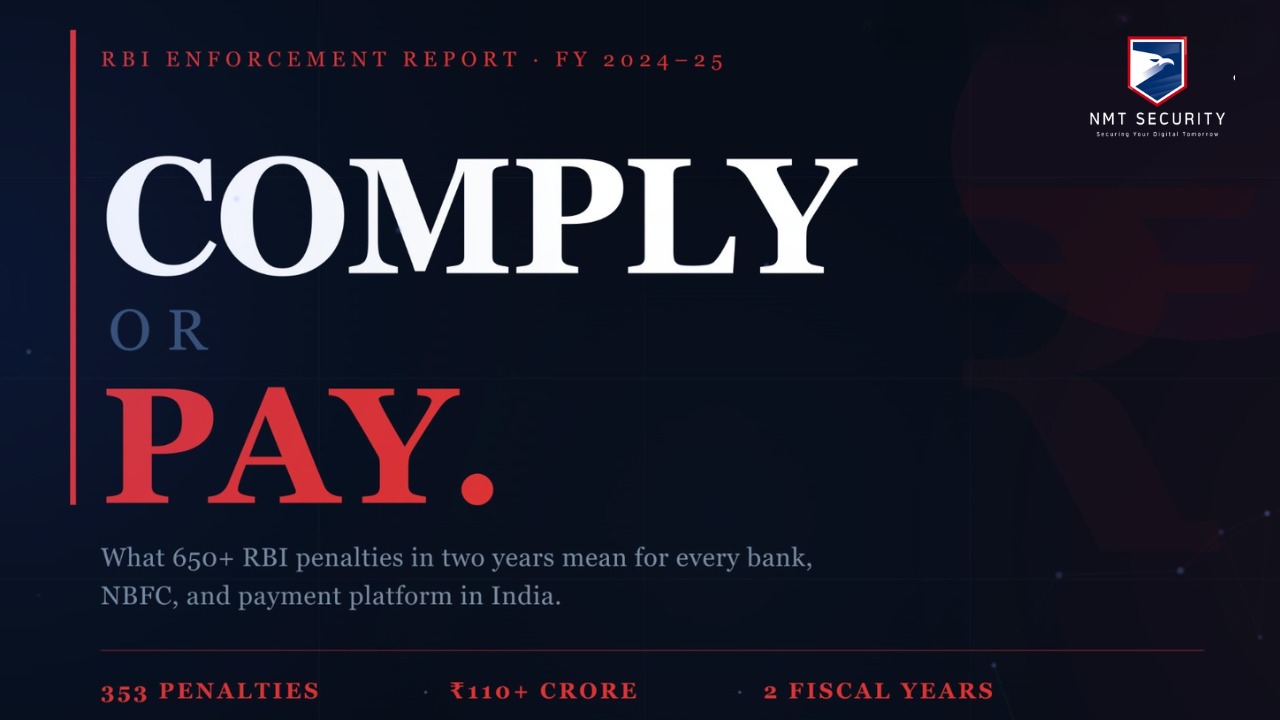
The Reserve Bank of India imposed 353 penalties totaling ₹54.78 crore in FY 2024-25. The year before that? Over 300 enforcement actions worth ₹56+ crore.
This isn’t a spike. It’s a pattern.
And it’s not limited to small players. ICICI Bank, Axis Bank, Bank of Baroda, Deutsche Bank India, Yes Bank, Pine Labs. All of them faced enforcement action in the last 12 months. Co-operative banks alone accounted for 264 penalties worth ₹15.63 crore in FY25.
The five risk indicators that keep showing up across these actions are:
→ KYC / AML non-compliance. Still the single biggest trigger
→ Cybersecurity framework gaps. ICICI was fined ₹97.80 lakh in May 2025 for this alone
→ CRILC reporting failures. Delayed or inaccurate submissions
→ Exposure norms and governance breakdowns. Related-party lending, board disengagement
→ Digital lending direction breaches. P2P violations, PPI issuance without KYC
The signal from the regulator is clear. RBI is no longer treating compliance as a formality. It’s an inspection item with financial and reputational consequences.
So what should CISOs, compliance leaders, and boards actually do?
Here are 10 things that need to be on your priority list right now.
1. Automate KYC lifecycle management end to end
KYC violations are the most common reason for RBI penalties. Period. And the root cause is almost always the same: incomplete documentation, outdated records, and third-party KYC delegation without oversight.
Manual KYC processes don’t scale. If your team is still chasing document updates on spreadsheets, you’re building penalty risk into your operations.
Automate customer onboarding verification, periodic re-KYC triggers (2 years for high-risk, 8 for medium, 10 for low), and CKYC uploads to CERSAI within 3 working days. RBI’s August 2025 KYC Master Direction amendment has tightened this further with deepfake-proof Video KYC requirements.
2. Implement a board-approved cybersecurity policy and review it quarterly
RBI’s Cybersecurity Framework mandates board-approved cybersecurity policies for all scheduled commercial banks. The IT Framework for NBFCs extends similar expectations based on asset size.
This is not a document that sits in a drawer. It needs quarterly reviews, mapped to current threat intelligence, and signed off at the board level. RBI inspectors check for this. If your last review was six months ago, that’s a finding.
3. Stand up a Security Operations Center or contract one
SOC capability is no longer a “good to have.” RBI expects 24/7 threat monitoring, detection, and incident response. For mid-size NBFCs and co-operative banks, outsourcing to a managed SOC is practical. But you still own the accountability.
Ensure your SOC covers endpoint detection, network monitoring, log correlation, and has documented escalation paths. RBI expects incident reporting within 2 to 6 hours of discovery.
4. Run VAPT at least twice a year and after every major change
Vulnerability Assessment and Penetration Testing is explicitly called out in RBI’s compliance testing requirements. Once a year is the bare minimum. Twice a year is the real expectation, plus after any significant infrastructure or application change.
The results need to feed into a remediation tracker with SLAs, not just a PDF report that goes to the audit committee. Track mean-time-to-remediate. That’s what auditors look at.
5. Fix your CRILC and CIC reporting pipeline
CRILC (Central Repository of Information on Large Credits) reporting failures are a consistent trigger for penalties. So is late or inaccurate submission of credit information to Credit Information Companies.
If your data pipeline has manual handoffs between core banking and reporting systems, that’s where errors enter. Automate the extraction, validation, and submission cycle. Flag anomalies before they reach the regulator.
6. Audit your third-party and fintech partnerships
RBI is conducting in-depth audits of NBFCs working with fintech Loan Service Providers. The focus is on KYC compliance, data privacy, and whether your partners operate with the same compliance rigor you do.
If you use LSPs, DLAs, or any outsourced digital channel, your board needs an approved oversight policy. Post May 2025, the Digital Lending Directions require DLA registration on the CIMS portal, board-approved digital lending policies, and updated LSP contracts. If you haven’t done this, you’re already in breach.
7. Map your compliance posture to RBI’s actual inspection checklist
Don’t prepare for compliance in theory. Prepare for how RBI actually inspects.
That means mapping your controls to specific RBI directions: Master Direction on KYC, Cybersecurity Framework, IRAC norms, Fair Practice Code, CRILC reporting guidelines, and the Digital Lending Directions 2025. Build an internal readiness scorecard that mirrors what an RBI inspection team will ask for.
If your compliance function can’t produce evidence for each control in under 24 hours, you’re not audit-ready.
8. Establish continuous monitoring for your external attack surface
Your attack surface is not static. New subdomains, exposed APIs, misconfigured cloud assets, leaked credentials. These change weekly. RBI’s cybersecurity framework expects institutions to have visibility into their external-facing digital footprint.
External Attack Surface Management (EASM) gives you that visibility. It’s not a one-time scan. It’s continuous discovery and risk scoring of every digital asset that can be exploited. This is where most institutions have a blind spot, and it’s increasingly what regulators expect you to have covered.
9. Bring compliance visibility to the board level with quantified risk
RBI’s 2024 penalty wave hit hardest where boards were disengaged from compliance. The highest single penalty in FY24 was ₹5.93 crore, slapped on a co-operative bank for governance failures: related-party lending, donations to board-linked trusts, and zero cybersecurity implementation.
Boards need dashboards, not decks. They need to see compliance posture as a risk metric, quantified in financial terms. What’s the cost of non-compliance? What’s the probability of a finding in the next inspection? What’s the remediation backlog? Present it in the language of risk, not the language of IT.
10. Build a compliance-as-code culture, not a checkbox culture
The institutions getting penalized aren’t being penalized because they don’t know the rules. They’re being penalized because compliance lives in a silo. Disconnected from operations, technology, and decision-making.
The shift RBI is pushing for is structural. Compliance needs to be embedded into product design, technology architecture, vendor onboarding, and board governance. Not reviewed once a quarter. Monitored continuously.
The organizations that treat compliance as an engineering problem, automated, measurable, and always-on, are the ones that won’t show up in RBI press releases.
The bottom line
₹110+ crore in penalties across two fiscal years. 650+ enforcement actions. And the scope keeps expanding. Banks to NBFCs to payment aggregators to P2P platforms.
RBI’s message is simple: if you’re regulated, you’re accountable. And the cost of reactive compliance is now higher than the cost of doing it right.
At NMT Security, we built NOVA AI as the intelligence layer for exactly this problem. One platform covering EASM, TPCRM, compliance readiness, vulnerability management, and continuous monitoring. CISOs and compliance teams get real-time visibility instead of quarterly surprises.
If this data resonates, it probably belongs on your next board deck.
More from the blog
See all articles
5 min read
Compliance Is the Baseline. Risk Is the Real Question.
For years, cybersecurity compliance was largely treated as a security function. Policies were documented, controls were tested, evidence was collected and audits were…

6 min read
Compliance Has Stages. The Risk Does Not Wait.
What does compliance really protect you from? The FICCI-EY Risk Survey 2026 found that 61% of respondents identified cyberattacks and data breaches as major financial…

7 min read
Cybersecurity Tool Sprawl: More Detection, Less Direction
There is a point in every organisation's security journey where adding another tool stops solving a security problem and starts creating one. A new endpoint threat leads…

See what Foresee finds on your own domain.
A 30-minute call. Share a domain and we will walk you through what we find.