Why Cyber Insurers Are Looking Beyond Questionnaires: The Growing Role of External Attack Surface Management
24 June 2026 · 4 min read
On this page
According to multiple cyber insurance industry reports, ransomware, business email compromise (BEC), and third-party incidents continue to account for a significant share of cyber claims, driving insurers to look beyond traditional underwriting questionnaires and toward continuously observable risk signals.
A cyber insurance application says everything looks good.
✅Multi-factor authentication is enabled.
✅Endpoint protection is deployed.
✅The company has passed its compliance audit.
✅The underwriting questionnaire comes back clean.
Six months later, a ransomware claim lands on the insurer's desk.
The breach investigation finds something surprising.
The attackers did not exploit a missing control.
They did not bypass an expensive security product.
They found a forgotten internet-facing asset the company didn't know existed. They purchased exposed credentials that had been circulating online for months. They impersonated employees using information gathered from public sources.
Everything that led to the breach was visible from the outside.
The scenario is becoming increasingly familiar across the cyber insurance industry.
As ransomware losses, business email compromise incidents, and third-party breaches continue to impact organizations worldwide, insurers are placing greater emphasis on externally observable risk indicators. Industry underwriting practices have evolved significantly in recent years, with many insurers incorporating signals such as exposed remote access services, email security posture, leaked credentials, and publicly visible vulnerabilities into cyber risk assessments.
The reason is simple: external exposure often provides a more accurate picture of an organization's attackability than self-reported security questionnaires alone.
The Cyber Insurance Industry Has A Visibility Problem
Cyber insurance has become significantly more sophisticated over the last decade.
Questionnaires are longer.
Security requirements are stricter.
Premium calculations are more detailed.
Yet a fundamental challenge remains.
Most underwriting processes still rely heavily on what organizations report about themselves.
Attackers do not.
Attackers evaluate organizations based on what they can actually see.
They do not care whether a company passed an audit six months ago. They care whether credentials are exposed today. They care whether internet-facing assets are misconfigured today. They care whether an employee can be impersonated today.
What attackers see is often very different from what appears in an underwriting questionnaire.
The Shift From Security Controls To Risk Intelligence
Historically, cyber insurance focused on whether security controls existed.
Today, insurers increasingly need to understand something more important:
How exposed is the organization right now?
Two companies can answer the same questionnaire identically.
Yet one may have:
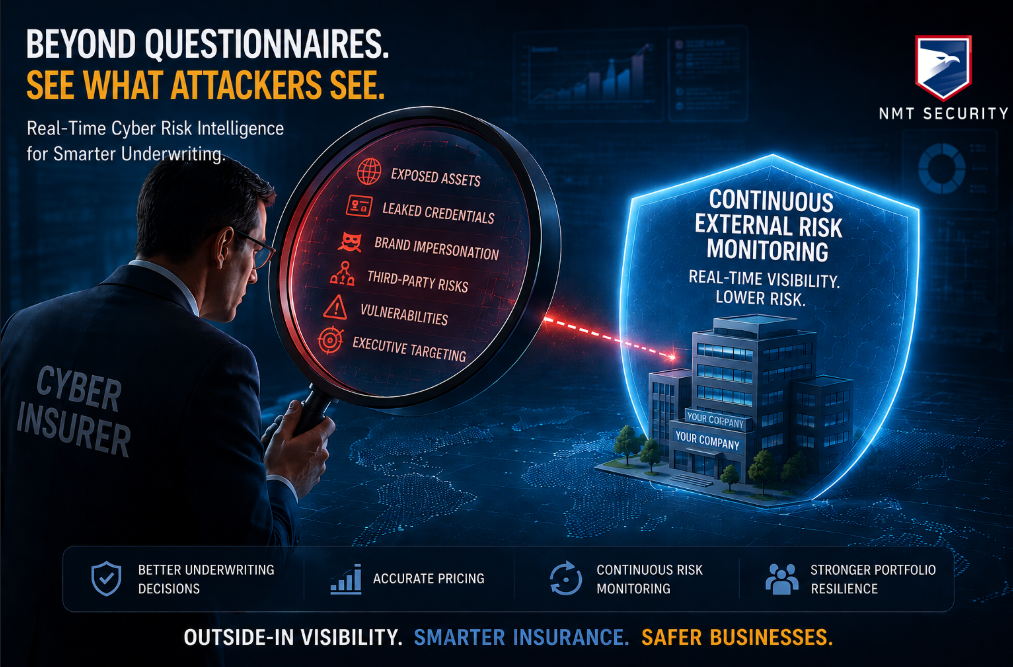
- Exposed credentials on underground forums
- Active brand impersonation campaigns
- Forgotten internet-facing assets
- Third-party vulnerabilities
- Executive targeting activity
The other may not.
The difference between those organizations is not compliance.
It is exposure.
And exposure is what attackers monetize.
Why EASM Matters To Insurers
External Attack Surface Management gives insurers visibility into the same attack surface attackers use during reconnaissance.
Instead of relying solely on point-in-time questionnaires, insurers gain access to continuously updated intelligence on:
- Internet-facing infrastructure
- Leaked credentials
- Executive exposure
- Brand impersonation
- Third-party risks
- Publicly exposed assets
- Dark-web intelligence
This visibility supports more informed underwriting decisions across the policy lifecycle.
For example, insurers can:
- Validate self-reported security controls against observable risk signals
- Identify exposure trends before policy renewal
- Improve pricing accuracy by incorporating real-world attack surface intelligence
- Prioritize high-risk applicants for deeper assessment
- Monitor portfolio-wide cyber exposure across insured organizations
The result is a more objective and dynamic understanding of cyber risk than questionnaires alone can provide.
Why EASM Matters To Brokers
For brokers, EASM changes the relationship with clients.
Instead of discussing theoretical risks during renewal season, brokers can provide ongoing visibility into actual exposures affecting their clients.
The conversation changes from:
"Do you have MFA?"
to
"We found credentials associated with your organization appearing in underground sources this week."
One is a compliance discussion.
The other is a business risk discussion.
It also creates opportunities for brokers to become strategic advisors rather than policy intermediaries. By providing continuous visibility into emerging cyber exposures, brokers can help clients reduce risk before renewal discussions begin, improving both insurability and long-term resilience.
From Periodic Assessments To Continuous Visibility
As cyber insurance evolves, the conversation is shifting from annual assessments to continuous cyber risk intelligence.
The challenge facing insurers today is not a lack of security data.
It is a lack of visibility into the risks that are actively exposed and exploitable at any given moment.
This is where platforms designed around continuous exposure monitoring are beginning to play a larger role.
At NMT Security, we believe the future of cyber insurance lies in continuous cyber risk intelligence rather than point-in-time assessments.
Through NOVA AI and NMT Security's Dynamic Risk Intelligence Model (DRIM), insurers and brokers gain a continuously updated view of external cyber exposure across:
- External Attack Surface Management
- Third-Party Risk Management
- Identity Exposure
- Vulnerability Intelligence
- Brand Risk Monitoring
- Threat Intelligence
This allows cyber risk to be evaluated as a living, changing condition rather than a once-a-year questionnaire exercise.
Because risk does not wait for renewal season.
Attackers certainly do not.
The Future Of Cyber Insurance Is Outside-In
Cyber insurance was built to help organizations recover from cyber incidents.
Increasingly, its value will come from helping organizations prevent them.
As cyber threats become more dynamic, underwriting models must evolve beyond static assessments and annual questionnaires. The organizations best positioned to manage cyber risk will be those that combine strong internal controls with continuous visibility into their external exposure.
Because the next major cyber claim rarely begins with a failed audit.
It begins with an exposed asset, a leaked credential, or a vulnerability that nobody knew existed.
It starts outside the network.
And the sooner insurers, brokers, and businesses begin looking at cyber risk the way attackers do, the sooner they can identify exposures before they become incidents, and incidents before they become claims.
More from the blog
See all articles
5 min read
Compliance Is the Baseline. Risk Is the Real Question.
For years, cybersecurity compliance was largely treated as a security function. Policies were documented, controls were tested, evidence was collected and audits were…

6 min read
Compliance Has Stages. The Risk Does Not Wait.
What does compliance really protect you from? The FICCI-EY Risk Survey 2026 found that 61% of respondents identified cyberattacks and data breaches as major financial…

7 min read
Cybersecurity Tool Sprawl: More Detection, Less Direction
There is a point in every organisation's security journey where adding another tool stops solving a security problem and starts creating one. A new endpoint threat leads…

See what Foresee finds on your own domain.
A 30-minute call. Share a domain and we will walk you through what we find.