Why a Better Security Posture Could Be Your Biggest Advantage at Cyber Insurance Renewal
2 July 2026 · 5 min read
On this page
- Risk Doesn't Stay Still
- The Customer Perspective: Cyber Insurance Should Do More Than Pay Claims
- Real-World Lessons: What Claims Data Keeps Showing
- What This Means for Policyholders
- A Different Way to Think About Premiums
- Where External Attack Surface Management Fits
- From Annual Assessment to Continuous Assurance
- The NMT Security Perspective
- Conclusion
For years, cyber insurance has followed a familiar pattern.
A business applies for coverage.
The insurer sends a questionnaire.
✅Security controls are reviewed.
✅Premiums are calculated.
✅The policy is issued.
For months, sometimes an entire year, everyone assumes the organization's risk remains largely unchanged.
But cyber risk doesn't work that way.
An employee reuses a password.
A forgotten cloud server becomes internet-facing.
A third-party vendor suffers a breach.
A phishing domain impersonating the company appears overnight.
None of these events wait until renewal season.
Yet most insurance assessments do.
That gap between how cyber risk changes and how cyber risk is measured is becoming one of the biggest challenges facing insurers, brokers, and policyholders alike.
Risk Doesn't Stay Still
Imagine two manufacturing companies.
✅Both answer the same underwriting questionnaire.
✅Both have ISO certifications.
✅Both use endpoint protection.
✅Both implement MFA.
On paper, they appear equally secure.
Six months later, one company has:
- Employee credentials for sale on underground forums.
- Three exposed internet-facing assets.
- A newly registered phishing domain.
- A supplier that has just disclosed a breach.
- Multiple executives being impersonated on social media.
The other company has none of these issues.
The policy hasn't changed.
The premium hasn't changed.
But the risk has changed dramatically.
The challenge isn't that insurers made the wrong decision.
The challenge is that cyber risk evolved after the underwriting process ended.
The Customer Perspective: Cyber Insurance Should Do More Than Pay Claims
Most organizations purchase cyber insurance for financial protection.
Increasingly, they expect something more valuable.
They expect help preventing incidents altogether.
Boards are asking different questions today.
Instead of asking,
"What happens if we're breached?"
they're asking,
"How do we reduce the chances of becoming the next breach?"
This represents a fundamental shift.
Cyber insurance is evolving from a financial product into a cyber resilience partnership.
That evolution depends on visibility.
Real-World Lessons: What Claims Data Keeps Showing
Modern breaches rarely happen because organizations forgot to buy security technology.
They happen because risks developed quietly over time.
Case Study 1: The Forgotten Asset
A retail company migrates workloads to the cloud. Months later, an old development server remains internet-facing. Nobody notices.
Attackers discover it through automated internet scanning. A ransomware incident follows. The vulnerability wasn't hidden.
The organization simply wasn't continuously monitoring its external exposure.
Case Study 2: The Credential That Nobody Knew Was Leaked
An employee reuses a corporate password on a third-party website. That website suffers a breach.
Months later, attackers purchase the credential from underground forums. The password still works. The initial compromise happens in minutes.
The credential had been publicly available for months.
Case Study 3: The Supplier Nobody Considered
A logistics provider experiences a cyber incident. Attackers use trusted integrations to move toward connected customers.
Suddenly, multiple organizations inherit risk from a breach they didn't cause.
Supply-chain attacks have become one of the defining characteristics of modern cyber incidents. The attack surface extends beyond organizational boundaries.
What This Means for Policyholders
Continuous external monitoring creates tangible benefits for insured organizations.
Earlier Detection
Instead of discovering exposed assets after an incident, organizations identify them while there is still time to remediate.
Better Security Prioritization
Security teams often face thousands of findings.
Knowing which external exposures are most likely to be exploited helps prioritize limited resources.
Stronger Renewal Conversations
Organizations that demonstrate measurable improvements in their external attack surface can present objective evidence during policy renewal discussions.
Cyber maturity becomes something that can be demonstrated rather than simply described.
Reduced Business Disruption
Preventing a ransomware incident is worth far more than successfully recovering from one.
The greatest value of cyber insurance may increasingly come from helping organizations avoid claims entirely.
A Different Way to Think About Premiums
Traditionally, premiums reflect historical information.
Increasingly, they can also reflect current cyber posture.
Imagine two policyholders.
One continuously reduces exposed assets, eliminates leaked credentials, improves email security, and addresses external vulnerabilities.
The other does none of those things.
Should both represent the same level of risk?
Probably not.
Continuous visibility creates opportunities for insurers to reward organizations actively reducing cyber exposure.
Much like telematics transformed automobile insurance, continuous cyber risk intelligence has the potential to reshape cyber underwriting.
Where External Attack Surface Management Fits
External Attack Surface Management provides organizations with an outside-in understanding of cyber exposure.
Rather than focusing exclusively on systems inside the corporate network, it continuously identifies publicly visible risks including:
- Internet-facing assets
- Shadow IT
- Cloud exposure
- Brand impersonation
- Executive targeting
- Credential exposure
- Third-party exposure
- Public vulnerabilities
For policyholders, this means fewer surprises.
For insurers, it means more informed underwriting.
For brokers, it creates more meaningful conversations around cyber resilience.
From Annual Assessment to Continuous Assurance
Cyber insurance has traditionally relied on snapshots.
But snapshots age quickly.
Risk changes every day.
The organizations best positioned for the future will continuously understand how their external exposure evolves rather than relying solely on annual assessments.
That doesn't replace questionnaires.
It complements them.
Together, they provide a far more accurate picture of organizational cyber risk.
The NMT Security Perspective
At NMT Security, we believe cyber insurance should be built on continuous understanding rather than periodic assumptions.
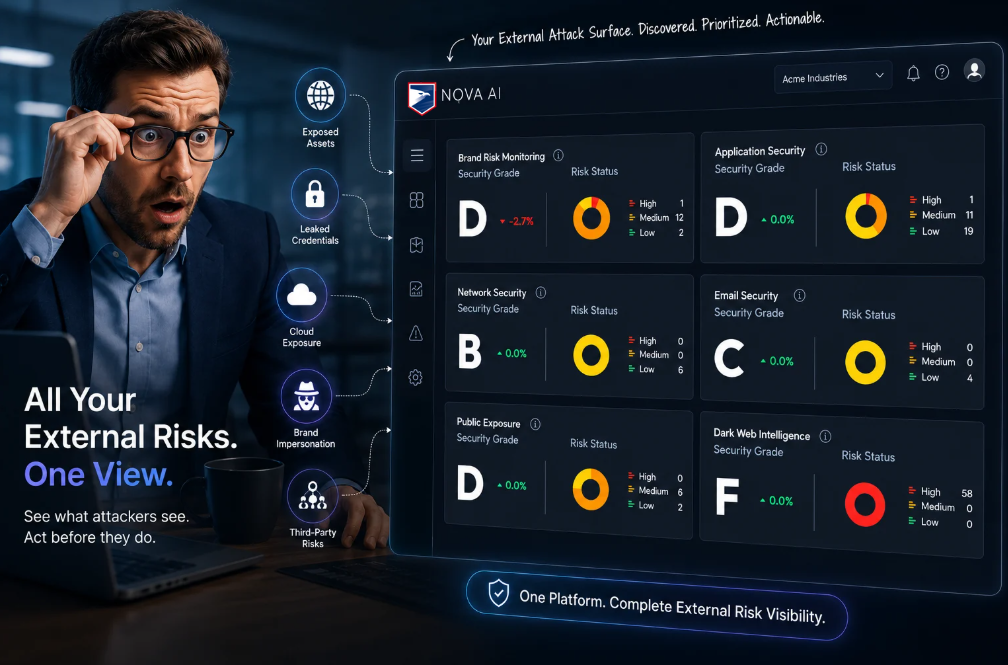
Through NOVA AI and our External Attack Surface Management capabilities, organizations gain ongoing visibility into the risks attackers see first-from exposed infrastructure and leaked credentials to brand impersonation, third-party exposure, and emerging threat intelligence.
For insurers, this enables more informed underwriting.
For brokers, it supports richer client conversations and stronger risk advisory services.
For policyholders, it provides something even more valuable than a successful claim:
The opportunity to prevent the claim from happening in the first place.
Conclusion
Cyber insurance is no longer just about transferring financial risk. It is becoming a shared commitment to reducing cyber risk.
Organizations want more than reimbursement.
Insurers want more predictable loss ratios.
Brokers want stronger client relationships.
All three objectives begin with the same requirement:
Better visibility. Because in cybersecurity, the risks that matter most are often the ones developing quietly beyond the perimeter.
And the organizations that see them first are the ones most likely to avoid becoming tomorrow's headline.
More from the blog
See all articles
5 min read
Compliance Is the Baseline. Risk Is the Real Question.
For years, cybersecurity compliance was largely treated as a security function. Policies were documented, controls were tested, evidence was collected and audits were…

6 min read
Compliance Has Stages. The Risk Does Not Wait.
What does compliance really protect you from? The FICCI-EY Risk Survey 2026 found that 61% of respondents identified cyberattacks and data breaches as major financial…

7 min read
Cybersecurity Tool Sprawl: More Detection, Less Direction
There is a point in every organisation's security journey where adding another tool stops solving a security problem and starts creating one. A new endpoint threat leads…

See what Foresee finds on your own domain.
A 30-minute call. Share a domain and we will walk you through what we find.