The Firefighter and the Fire Marshal: Why Most Security Teams Are Fighting the Wrong Battle
8 July 2026 · 3 min read
On this page
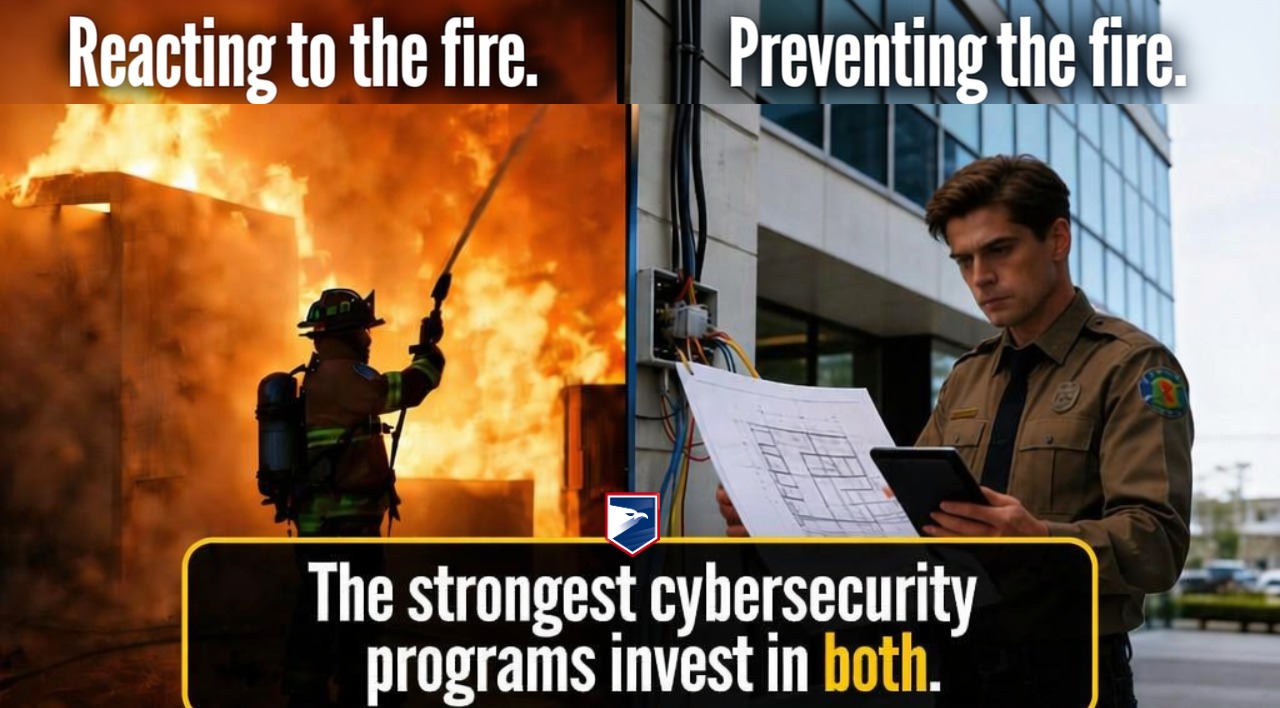
Every Organisation Has Firefighters. Who Is Your Fire Marshal?
Every organisation has firefighters. Skilled ones. The alert fires, the team scrambles, the incident gets contained, everyone exhales. It is heroic work, it is exhausting, and it never ends.
The harder question is this: who is your Fire Marshal?
The Difference Between a Firefighter and a Fire Marshal
Think about how fire safety actually works. The firefighter runs toward the burning building. They are reactive by design. You only need them once the fire has started, and by then the damage is measured in what you lose, not what you saved.
The Fire Marshal never touches a hose. Their job happens before anything is alight. They walk the building and ask uncomfortable questions. Where are the exits? Are they blocked? Is the wiring up to code? Who holds keys to which doors? What is stored next to the boiler? They map every way the building could burn, they score the risk, and they force the changes that mean the fire either never starts or never spreads.
A building with a great fire department and no Fire Marshal burns down on schedule. It just responds faster when it does.
Cybersecurity Has the Same Gap
Security has the same gap, and almost nobody funds the second role.
A decade of budget has gone into firefighting: detection, response, SOCs, alerts, playbooks. All necessary. None of it prevents the fire. It tells you the building is already alight and helps you contain it before the whole block goes.
Meanwhile attackers do their homework like arsonists casing a property. They find the exposed asset nobody remembered, the forgotten subdomain, the vendor with weak controls, the credentials sitting on the dark web, the AI tool an employee wired into company data last Tuesday. These are the blocked exits and the faulty wiring. A firefighter cannot see them. It is not their job to.
This Is the Job NMT Security Was Built to Do
We are the Fire Marshal.
We work outside-in, the way an attacker sees you and the way a Marshal walks a building before signing off on it.
External Attack Surface Management (EASM)
EASM continuously maps your external attack surface across six lenses: brand, applications, network, email, public exposure, and the dark web. It surfaces the assets, exposed services, and leaked data you did not know were still yours, then grades the risk A-F so a board member can read it without a translator.
Third-Party Risk Management (TPRM)
Third-Party Risk (TPRM) watches the buildings next to yours. A fire in a vendor spreads to you, so we continuously monitor and re-tier the partners you depend on rather than trusting a questionnaire from eighteen months ago.
AI Governance
AI Governance answers the question every board is now asking: where is our data going, and which AI tools are quietly touching it? We map the shadow AI usage, apply policy, and monitor every prompt and response against it.
NOVA
NOVA, our AI analyst, ties it together. It correlates attack chains, prioritises what to fix first from P0 to P3, and quantifies the likely dollar impact by industry, size, and region. It tells you what matters before it becomes an incident, not after.
Firefighters Will Always Be Needed
None of this replaces your firefighters. You will always need them. But if the only security function you fund shows up after the fire, you have accepted that fires are inevitable and that your only lever is response time.
The organisations that stop burning down are the ones that finally hired a Fire Marshal.
One Question
So, one question: in your security programme, who is walking the building before the fire starts, and when did they last hand you the list of what to fix?
Find out in ten minutes. Get a free risk score of your external attack surface, or book a walkthrough with our team. Links below.
And if this framing lands, tell us in the comments:
Are you funding firefighters, or a Fire Marshal?
More from the blog
See all articles
5 min read
Compliance Is the Baseline. Risk Is the Real Question.
For years, cybersecurity compliance was largely treated as a security function. Policies were documented, controls were tested, evidence was collected and audits were…

6 min read
Compliance Has Stages. The Risk Does Not Wait.
What does compliance really protect you from? The FICCI-EY Risk Survey 2026 found that 61% of respondents identified cyberattacks and data breaches as major financial…

7 min read
Cybersecurity Tool Sprawl: More Detection, Less Direction
There is a point in every organisation's security journey where adding another tool stops solving a security problem and starts creating one. A new endpoint threat leads…

See what Foresee finds on your own domain.
A 30-minute call. Share a domain and we will walk you through what we find.