We Didn't Build Our Company Once. We Rebuilt It Every Quarter.
13 July 2026 · 5 min read
On this page
If you've ever visited a startup's website more than once in a year, you've probably noticed something.
It changed.
Sometimes subtly. Sometimes dramatically.
Ours certainly did.
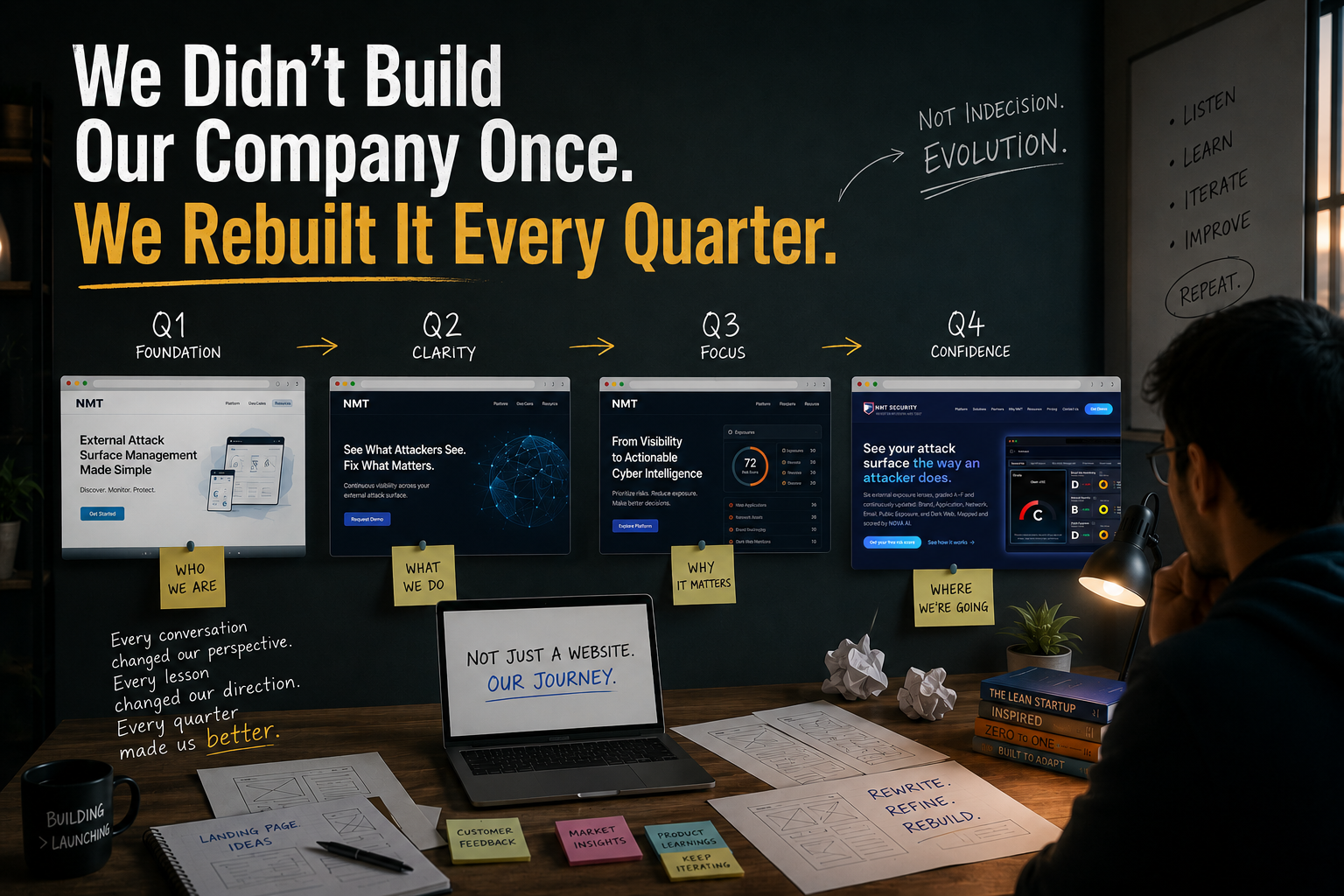
Over the last twelve months, we redesigned our website four times.
From the outside, that might look like indecision. Why would a company keep changing something that was already live?
Inside the company, it meant something entirely different.
It meant we were learning.
One of the biggest misconceptions about startups is that founders begin with perfect clarity. They don't. They begin with a problem they believe is worth solving and a vision of where they want to go. Everything else, how they communicate, how they position themselves, and even how they describe their own product, evolves with every customer conversation, every product iteration, and every lesson learned.
You don't build a startup once.
You build it every single day.
The Startup Nobody Sees
When people think about startups, they usually picture the exciting parts.
A product launch.
A funding announcement.
A new customer.
A growing team.
What they rarely see is everything happening between those milestones.
They don't see the landing page being rewritten for the fifth time because customers still don't understand the message.
They don't see weeks of engineering effort being redirected after a customer reveals that the feature everyone internally loved isn't actually solving their biggest problem.
They don't see founders debating whether a single word on the homepage better explains the product than another.
Those moments never make headlines.
Yet they define almost every successful startup.
Startups aren't built through one breakthrough moment. They're built through thousands of small corrections that, over time, point the company in the right direction.
Every Customer Changes the Company
One of the first lessons every startup learns is that customers don't always buy what you think you're selling.
You might spend months perfecting a feature that nobody asks about.
Then, during a customer meeting, someone spends thirty minutes discussing something you considered a minor capability.
That single conversation changes your roadmap.
A few weeks later, the messaging changes.
Soon after, the product evolves.
Eventually, the website changes too.
Not because the original idea failed.
Because your understanding became better.
Customers don't just validate products.
They shape companies.
Why We Changed Our Website Four Times
Changing a website four times in a year isn't something most companies would proudly admit.
We would.
Because every version represented the company we were at that moment.
Our first website explained what we had built.
The second tried to explain why it mattered.
The third reflected what customers were actually asking us.
The fourth represented something deeper: a clearer understanding of the market we serve.
As we spoke with CISOs, founders, insurers, compliance leaders, and enterprise security teams, we noticed something interesting.
The questions evolved.
Initially, people wanted to understand what our platform did.
Later, they wanted to know how it was different.
Eventually, the conversation shifted entirely.
They weren't asking about features anymore.
They were asking how we help organizations make better security decisions.
Those aren't the same questions.
And a website built to answer yesterday's questions won't resonate with tomorrow's customers.
So we rebuilt it.
Not because we were uncertain.
Because we were listening.
Building While Running
Unlike established enterprises, startups rarely have the luxury of doing one thing at a time.
Product development doesn't pause while marketing catches up.
Sales doesn't wait until documentation is finished.
Customer success doesn't begin after every process has been perfected.
Everything happens simultaneously.
On the same day, you might spend the morning discussing AI capabilities with a prospect, review compliance evidence before lunch, help design a dashboard in the afternoon, and end the evening debating product strategy.
It can feel chaotic.
But that is often what progress looks like in an early-stage company.
You're building the business while the business is already running.
The Competitive Advantage Nobody Measures
People often assume a startup's biggest advantage is its technology.
Or its funding.
Or the speed at which it can innovate.
Those things matter.
But one quality matters even more.
The willingness to admit that yesterday's assumptions may no longer be the right ones.
Listening sounds passive.
It isn't.
Listening means changing.
It means accepting that your customers understand their problems better than you ever will.
It means allowing feedback not ego to shape the next version of your company.
That takes humility.
It also builds better businesses.
Success Looks Much Messier Than Social Media Suggests
LinkedIn celebrates outcomes.
It celebrates funding rounds, customer wins, product launches, and company milestones.
What it rarely celebrates is iteration.
Nobody posts about deleting months of work because the market changed.
Nobody announces that the messaging they spent weeks refining no longer reflects the product.
Nobody celebrates redesigning an entire website because they realised customers were asking different questions.
Yet those moments happen inside startups every week.
Progress is often invisible while it's happening.
Only in hindsight does it look inevitable.
The Startup Paradox
People often ask startups a simple question.
"When will the product be finished?"
The honest answer is:
Hopefully, never.
Not because the product isn't good enough.
But because the world refuses to stand still.
Technology changes.
Threats evolve.
Customer expectations rise.
Markets mature.
If the company stops evolving, it slowly becomes less valuable to the people it exists to serve.
The same is true for the product.
The website.
The messaging.
Even the company itself.
Growth isn't about protecting yesterday's decisions.
It's about continuously making better ones.
Looking Back
Today, when we look back at our first website, we don't see mistakes.
We see the beginning of a journey.
The second version reminds us how much we have learned.
The third reflects growing confidence.
The fourth represents a company with a much clearer understanding of its customers and the problems they face.
None of those versions were wasted effort.
Each one captured a moment in the evolution of the company.
More importantly, each one was made possible because customers challenged our assumptions, our team embraced change, and we remained willing to improve instead of becoming comfortable.
The Reality Behind Every Startup
Every successful startup has its own version of this story.
Products change.
Roadmaps evolve.
Messaging gets rewritten.
Websites are redesigned.
Ideas mature.
What rarely changes is the mission.
Behind every polished product is a team constantly questioning whether there's a better way to solve the problem they're passionate about.
From the outside, that looks like constant change.
From the inside, it looks like continuous learning.
And perhaps that's the most honest definition of a startup.
Not a company that has everything figured out.
But one that is willing to keep learning until it does.
More from the blog
See all articles
5 min read
Compliance Is the Baseline. Risk Is the Real Question.
For years, cybersecurity compliance was largely treated as a security function. Policies were documented, controls were tested, evidence was collected and audits were…

6 min read
Compliance Has Stages. The Risk Does Not Wait.
What does compliance really protect you from? The FICCI-EY Risk Survey 2026 found that 61% of respondents identified cyberattacks and data breaches as major financial…

7 min read
Cybersecurity Tool Sprawl: More Detection, Less Direction
There is a point in every organisation's security journey where adding another tool stops solving a security problem and starts creating one. A new endpoint threat leads…

See what Foresee finds on your own domain.
A 30-minute call. Share a domain and we will walk you through what we find.