When FIFA Lets AI Become the Referee, Who Governs the Referee?
22 July 2026 · 4 min read
On this page
The FIFA Club World Cup has become more than a showcase of football.
It has become a showcase of artificial intelligence.
Semi-automated offside technology, goal-line technology, player tracking, predictive analytics, and real-time decision support have transformed how the modern game is officiated. Decisions that once relied solely on human judgement are now supported by systems capable of analysing thousands of data points in fractions of a second.
For millions of fans, the expectation is simple.
Get the decision right.
But behind every AI-assisted decision lies a far more important question.
Not whether the technology works.
Whether the technology itself can be trusted.
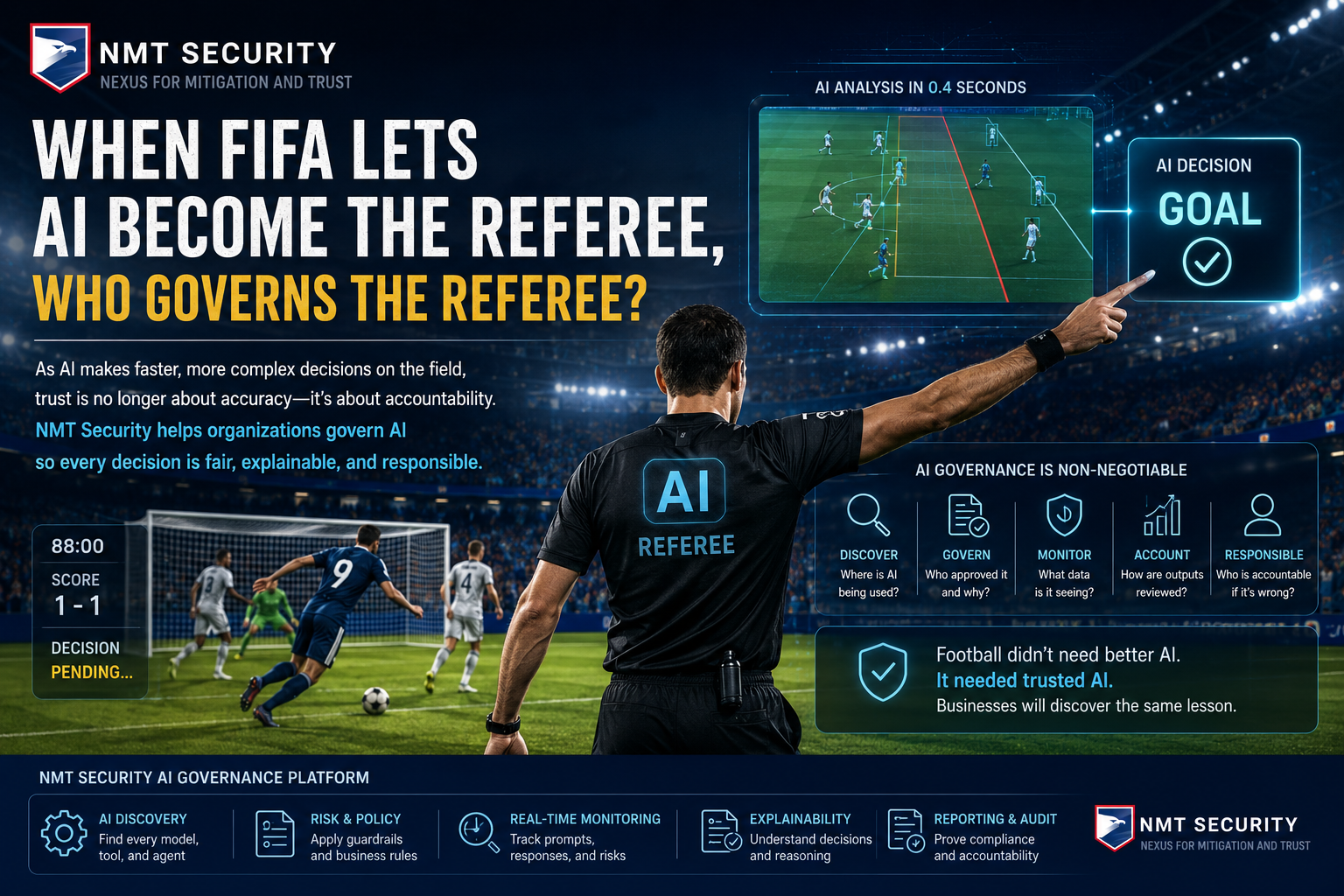
Imagine the World Cup Final
It is the 88th minute.
The score is 1–1.
A striker breaks through the defensive line.
The stadium rises to its feet.
The assistant referee raises the flag.
VAR intervenes.
The referee walks towards the pitch-side monitor.
Except this time...
There is no monitor.
There is no VAR official.
There is no referee reviewing slow-motion footage.
Instead, an AI system analyses:
- The position of all 22 players.
- Ball trajectory.
- Historical player movement.
- The offside line.
- Potential obstruction.
- Goalkeeper visibility.
In less than half a second...
The decision appears.
Goal.
Or perhaps...
No Goal.
Within seconds, millions celebrate.
Millions disagree.
The debate begins immediately.
But this time, the discussion isn't about whether the referee made the right decision.
It's something much bigger.
Who audited the AI that made it?
Who validated the model?
Who tested it?
Who approved it?
Who understands why it reached that conclusion?
Most importantly...
Who is accountable if the AI gets it wrong?
Football Isn't Really the Story
Football simply gives us a glimpse into a much larger future.
Because the same questions are quietly emerging across every industry.
Banks are using AI to assess creditworthiness.
Hospitals are using AI to support clinical decisions.
Insurance companies are using AI to detect fraud and evaluate claims.
Supply chains are using AI to optimise logistics.
Governments are using AI to assist public services.
Recruiters are using AI to shortlist candidates.
The conversation has changed.
A few years ago, organisations asked,
"Can AI do this?"
Today, the more important question is:
Should AI be making this decision, and if so, who governs it?
AI Adoption Has Outpaced AI Governance
Organisations didn't adopt one AI tool.
They adopted dozens.
Sometimes hundreds.
ChatGPT.
Claude.
Gemini.
Microsoft Copilot.
GitHub Copilot.
Enterprise copilots.
Internal large language models.
Autonomous AI agents.
Customer service bots.
Code generation assistants.
Document summarisation tools.
Meeting assistants.
Procurement assistants.
Marketing assistants.
The speed of adoption has been remarkable.
The speed of governance has not.
Across many organisations, AI has entered through individual teams long before it entered through corporate policy.
Employees experiment.
Departments subscribe.
Business units automate.
Innovation accelerates.
Visibility disappears.
The Questions Every Board Should Be Asking
Most organisations can tell you how many laptops they own.
They can usually identify every server connected to the network.
Many maintain accurate inventories of software assets.
Far fewer can answer equally fundamental questions about AI.
Where are all the AI models currently being used?
Which business decisions rely on them?
What data is being shared with them?
Who approved their use?
Which outputs are reviewed by humans?
How are hallucinations identified?
What happens when an AI recommendation causes financial, operational, or reputational harm?
These are no longer technical questions.
They are governance questions.
And governance has always been a board responsibility.
Trust Doesn't Come From Intelligence
One of the biggest misconceptions surrounding AI is that better models automatically create better outcomes.
They don't.
More capable AI does not automatically mean more trustworthy AI.
Trust comes from governance.
It comes from knowing where AI is deployed.
Understanding how it is trained.
Monitoring how it behaves.
Defining when humans intervene.
Documenting accountability.
Continuously assessing risk.
Football didn't introduce VAR because referees were incapable.
It introduced oversight because the consequences of decisions mattered.
The same principle applies to AI.
As AI systems become more autonomous, organisations need stronger governance-not simply smarter algorithms.
The New Competitive Advantage
Many executives still view AI governance as a compliance exercise.
It isn't.
It is rapidly becoming a business capability.
Organisations that understand where AI exists, how it is being used, and how decisions are governed will move faster with greater confidence.
Those that don't may find themselves asking difficult questions after an incident rather than before one.
Just as cybersecurity evolved from protecting infrastructure to protecting trust, AI governance is evolving from policy documentation to operational decision-making.
The organisations that succeed won't necessarily be the ones using the most AI.
They will be the ones using AI most responsibly.
The NMT Security Perspective
At NMT Security, we believe AI governance begins with visibility.
Before organisations can govern AI, they need to know where it exists, what data it accesses, how decisions are made, and whether those decisions align with organisational policy, regulatory requirements, and business objectives.
That is why modern AI governance extends beyond documentation.
It requires continuous discovery, monitoring, accountability, and oversight across the AI lifecycle.
Because governance isn't about slowing innovation.
It's about making innovation trustworthy.
Final Thoughts
Football didn't need better AI.
It needed trusted AI.
Businesses will discover exactly the same lesson.
The organisations that thrive in the AI era won't simply build smarter systems.
They'll build systems people are willing to trust.
Because every time AI makes a decision, someone is still accountable for the outcome.
The only question is whether they've prepared for that responsibility.
More from the blog
See all articles
5 min read
Compliance Is the Baseline. Risk Is the Real Question.
For years, cybersecurity compliance was largely treated as a security function. Policies were documented, controls were tested, evidence was collected and audits were…

6 min read
Compliance Has Stages. The Risk Does Not Wait.
What does compliance really protect you from? The FICCI-EY Risk Survey 2026 found that 61% of respondents identified cyberattacks and data breaches as major financial…

7 min read
Cybersecurity Tool Sprawl: More Detection, Less Direction
There is a point in every organisation's security journey where adding another tool stops solving a security problem and starts creating one. A new endpoint threat leads…

See what Foresee finds on your own domain.
A 30-minute call. Share a domain and we will walk you through what we find.