Compliance Isn't Dying. It's Growing Up.
29 July 2026 · 6 min read
On this page
For decades, compliance has been associated with documentation, evidence collection, policy reviews, and audit preparation. Organisations have invested significant time and resources into proving that controls exist, regulations are being followed, and governance requirements are being met. Entire teams spend weeks collecting screenshots, reviewing spreadsheets, coordinating with business units, and preparing documentation for audits that may only last a few days. Once the audit concludes, the cycle begins again for the next framework, the next regulator, or the next customer assessment.
Artificial Intelligence is beginning to change that rhythm.
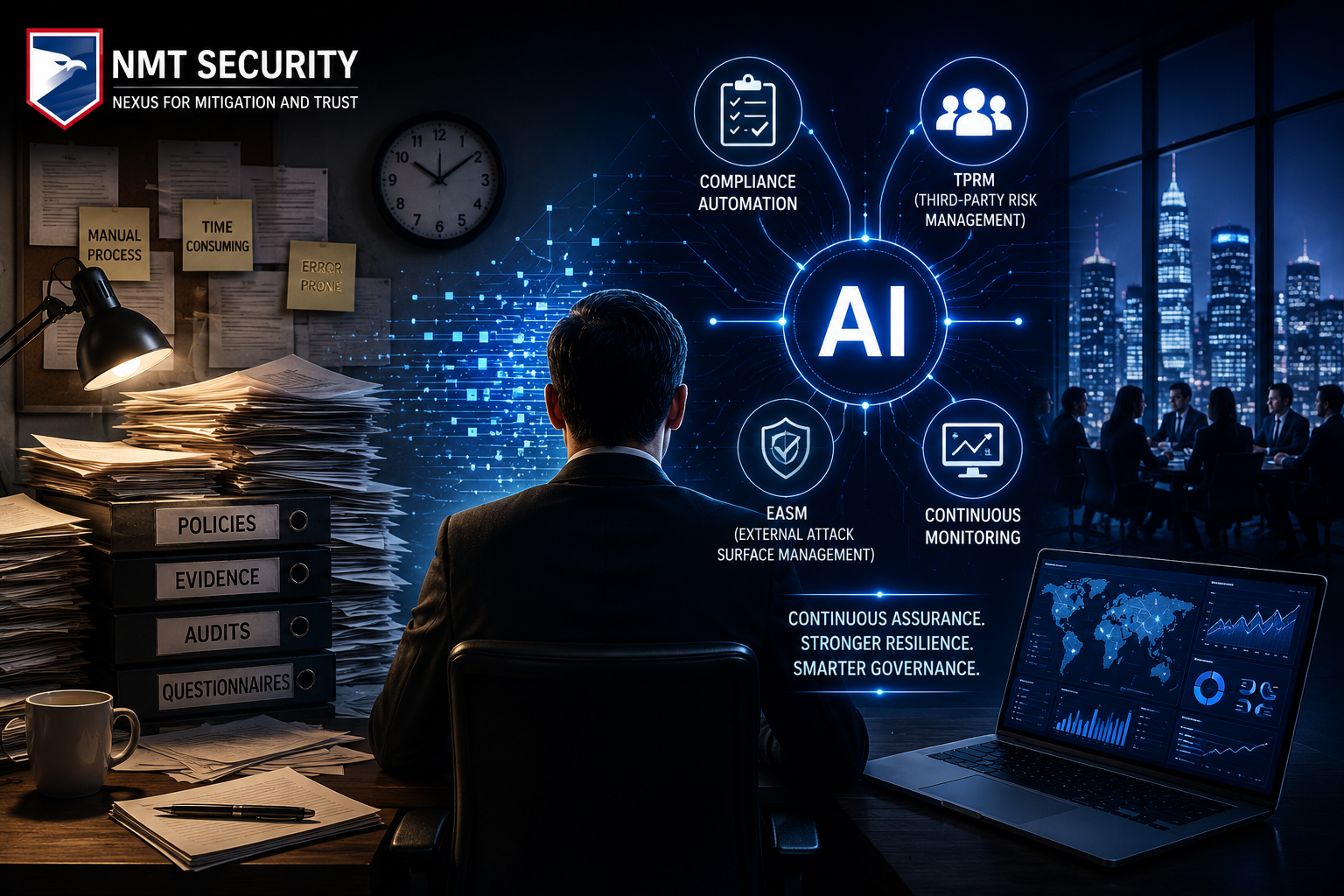
Tasks that once required hours of manual effort - mapping controls across frameworks, drafting policies, summarising regulatory requirements, reviewing questionnaires, identifying compliance gaps, and collecting evidence; can now be completed in minutes. What once represented the majority of a compliance professional's workload is steadily becoming automated.
For many people, this raises an uncomfortable question.
If AI can perform so much of compliance work, what happens to compliance professionals?
The answer is surprisingly simple.
AI is not replacing compliance.
It is removing the work that compliance professionals were never hired to do in the first place.
The Spreadsheet Was Never the Job
Walk into almost any compliance department today and you will find highly skilled professionals spending an extraordinary amount of time on administrative activities. They follow up on evidence requests, reconcile spreadsheets, update control matrices, review the same vendor questionnaires repeatedly, and manually compare one regulatory framework against another. These tasks are undoubtedly necessary, but they rarely represent the highest value that experienced governance professionals can provide.
Somewhere along the way, organisations began confusing documentation with governance. Passing an audit became the objective rather than demonstrating resilience. Completing a checklist became more important than understanding whether the underlying risk had actually been reduced.
Compliance was never intended to become a paperwork exercise.
Its purpose has always been to help organisations make better decisions about risk.
AI is simply giving the profession an opportunity to return to that original purpose.
AI Doesn't Replace Compliance Professionals. It Repositions Them.
There is an important distinction between replacing a profession and transforming it.
Artificial Intelligence excels at structured, repetitive work. It can review hundreds of policies in minutes, compare multiple regulations simultaneously, identify missing controls, generate draft documentation, summarise audit findings, and produce responses to security questionnaires with remarkable speed. These are valuable capabilities because they eliminate repetitive effort, reduce inconsistency, and allow compliance teams to focus on higher-value activities.
What AI cannot do is determine an organisation's risk appetite, balance competing business priorities, understand organisational culture, or explain complex trade-offs to executive leadership. Those responsibilities require context, experience, judgement, and accountability.
The future compliance professional will spend less time creating information and significantly more time interpreting it.
The New Job Description
The responsibilities of compliance teams are already beginning to shift.
Historically, success was measured by operational metrics. Teams focused on collecting evidence, completing control testing, maintaining documentation, and ensuring that audit requirements were satisfied on time. These activities remain important, but they no longer represent the full value of governance.
Increasingly, executive leadership expects compliance teams to answer different questions. Rather than simply confirming that controls exist, they are expected to explain whether those controls meaningfully reduce organisational risk. Instead of reporting that an audit was completed successfully, they must demonstrate how governance investments improve resilience, reduce exposure, and support business objectives.
That transition changes compliance from an operational function into a strategic advisory capability.
Boards Don't Care About Control IDs
Imagine presenting two quarterly updates to your Board.
The first presentation explains that 97 percent of controls have been tested, evidence has been collected, and all documentation has been updated according to schedule. While technically accurate, it tells the Board very little about the organisation's current risk position.
The second presentation explains that third-party cyber exposure has decreased by 34 percent, externally exposed assets have been reduced, and the organisation has significantly improved its resilience against ransomware and supply-chain attacks over the previous quarter.
Both presentations describe compliance activity.
Only one enables better business decisions.
Boards rarely make decisions based on control identifiers or audit completion percentages. They make decisions based on business impact, operational resilience, financial exposure, and strategic risk.
Artificial Intelligence enables compliance professionals to spend less time producing evidence and more time explaining what that evidence actually means.
The Compliance Team Is Becoming a Risk Intelligence Team
Perhaps the most significant transformation is that compliance is no longer limited to periodic assessments.
Historically, governance looked backwards. It asked whether policies had been followed, whether controls had been tested, and whether evidence existed to satisfy regulatory requirements. Those questions remain relevant, but they no longer provide a complete picture of organisational risk.
Continuous monitoring, AI-driven analysis, and real-time visibility are changing that model. Organisations are increasingly able to identify emerging risks as they develop rather than discovering them during the next audit cycle. Compliance evolves from a point-in-time assessment into an ongoing understanding of organisational resilience.
In many ways, compliance is becoming less about audits and more about intelligence.
The Real Competitive Advantage Isn't Automation
Eventually, nearly every organisation will adopt AI in some form.
Automation alone will not create competitive advantage because it will become the industry standard rather than the exception.
The organisations that differentiate themselves will be those that combine AI-generated insight with human judgement. AI can surface hundreds of potential risks, compare thousands of regulatory requirements, and produce recommendations at remarkable speed. Leadership must still determine which risks deserve immediate attention, how resources should be allocated, and what level of risk the organisation is prepared to accept.
Artificial Intelligence produces information.
Governance transforms information into decisions.
That relationship is not disappearing.
It is becoming more important than ever.
The NMT Security Perspective
At NMT Security, we believe the future of compliance is not about replacing professionals, it is about enabling them to focus on what matters most: governance, judgement, and risk-informed decision-making.
Artificial Intelligence is already transforming how compliance teams work. Activities that once consumed weeks; drafting policies, mapping controls across multiple frameworks, preparing audit evidence, responding to security questionnaires, and performing initial gap assessments-can increasingly be accelerated through AI. Rather than spending valuable time on repetitive administrative tasks, compliance teams can redirect their attention towards understanding risk, advising the business, and strengthening organisational resilience.
But automation alone is not enough.
The real challenge begins after compliance activities are completed.
A policy written by AI still needs to reflect the organisation's objectives. A control mapped by AI still needs to be monitored. A risk assessment generated today may no longer represent reality six months from now. Governance cannot remain a point-in-time exercise in an environment where technology, threats, and regulations evolve continuously.
That is why we believe compliance should move beyond periodic assessments towards continuous assurance.
Through NOVA AI, organisations can accelerate compliance activities while maintaining governance and human oversight throughout the lifecycle. Beyond documentation and audit readiness, NMT Security extends this approach through Third-Party Risk Management (TPRM) and External Attack Surface Management (EASM), enabling organisations to continuously monitor the risks that traditional audits often miss.
While compliance demonstrates that controls exist, TPRM continuously evaluates the evolving risks introduced by vendors and suppliers, and EASM provides an outside-in view of internet-facing assets, exposed services, leaked credentials, brand risks, and other external exposures that change every day.
Together, these capabilities shift organisations away from treating compliance as an annual milestone and towards treating it as a continuous business capability-one where AI accelerates execution, governance provides accountability, and continuous monitoring ensures that today's compliant organisation does not become tomorrow's security incident.
Because compliance should never be measured by how much documentation an organisation produces.
It should be measured by how confidently the organisation can understand, govern, and continuously reduce its risk.
More from the blog
See all articles
5 min read
Compliance Is the Baseline. Risk Is the Real Question.
For years, cybersecurity compliance was largely treated as a security function. Policies were documented, controls were tested, evidence was collected and audits were…

6 min read
Compliance Has Stages. The Risk Does Not Wait.
What does compliance really protect you from? The FICCI-EY Risk Survey 2026 found that 61% of respondents identified cyberattacks and data breaches as major financial…

7 min read
Cybersecurity Tool Sprawl: More Detection, Less Direction
There is a point in every organisation's security journey where adding another tool stops solving a security problem and starts creating one. A new endpoint threat leads…

See what Foresee finds on your own domain.
A 30-minute call. Share a domain and we will walk you through what we find.