The Next Competitive Advantage: AI Adoption with Governance
6 August 2026 · 5 min read
On this page
- AI Adoption Creates Opportunity. Governance Creates Confidence.
- Every AI Journey Begins With Visibility
- An AI Inventory Is the Foundation-Not the Destination
- Good Governance Is Risk-Based, Not Restrictive
- Your AI Ecosystem Extends Beyond Your Organisation
- Governance Doesn't End at Deployment
- The Rise of AI Platformization
- The NMT Security Perspective
- The Next Competitive Advantage
For the past three years, one question has dominated boardrooms across every industry.
"What is our AI strategy?"
Organisations have been exploring generative AI, deploying copilots, automating business processes, and embedding intelligent assistants into everyday operations. What began as experimentation has rapidly evolved into enterprise-wide adoption, with AI now influencing decisions across finance, legal, marketing, customer service, software engineering, and virtually every business function.
The urgency is understandable.
No organisation wants to miss the opportunities that AI presents.
Productivity improves.
Innovation accelerates.
Decisions become faster.
Competitive advantage grows.
AI adoption is no longer optional.
It is becoming a business imperative.
But as organisations accelerate adoption, another reality is becoming equally important.
The organisations that create lasting value from AI won't simply adopt it faster. They'll adopt it responsibly, with governance built in from the beginning.
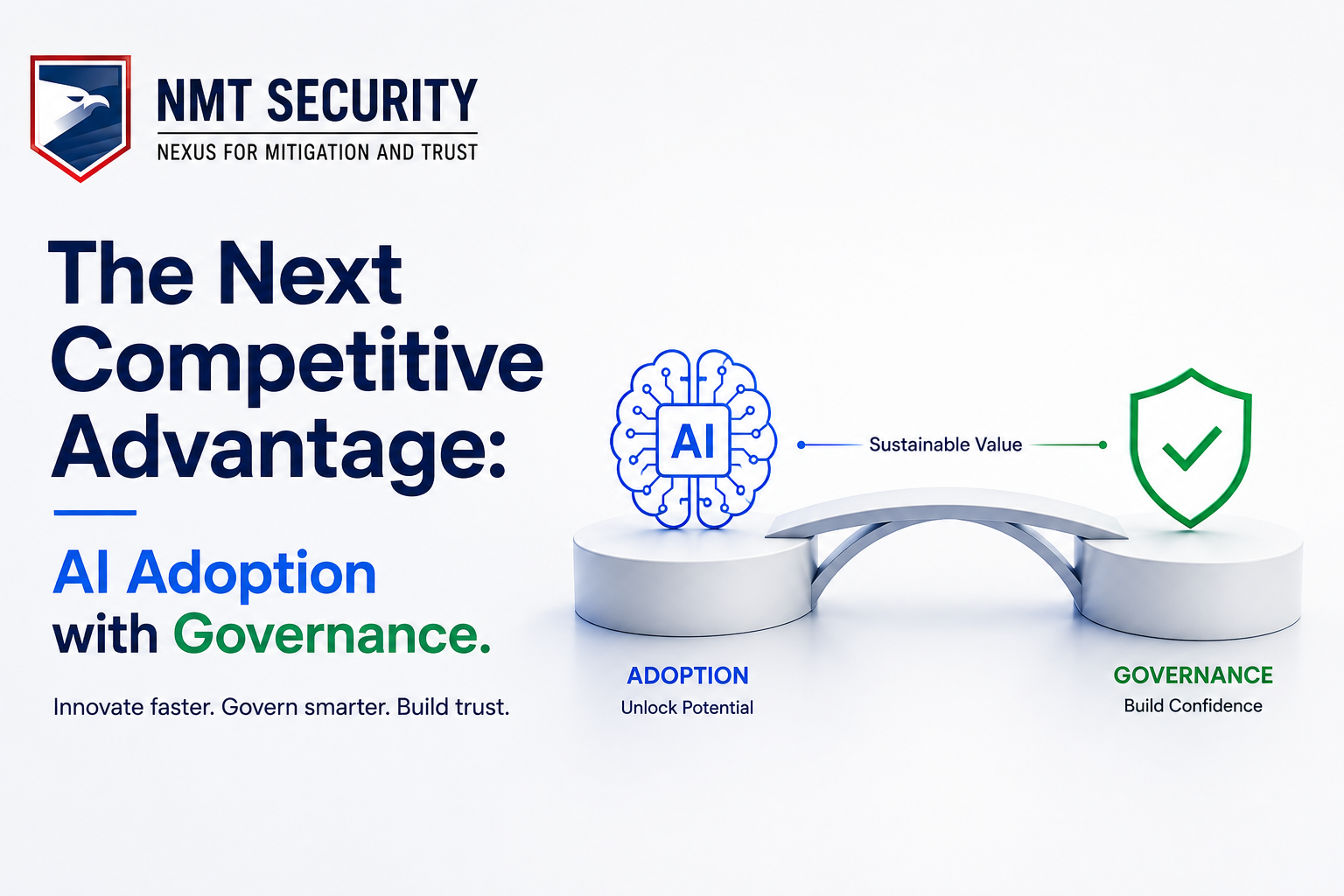
Adoption and governance are not competing priorities.
They are complementary capabilities.
AI Adoption Creates Opportunity. Governance Creates Confidence.
Every major technology shift has followed a familiar pattern.
The internet transformed business before cybersecurity matured.
Cloud computing scaled long before cloud governance became standard practice.
Mobile applications reached millions before organisations understood privacy at scale.
Artificial Intelligence is following the same trajectory.
Organisations are investing heavily because the business value is clear. AI enables teams to automate repetitive work, improve operational efficiency, accelerate decision-making, and unlock entirely new ways of working.
The challenge is not that organisations are adopting AI too quickly.
The challenge is ensuring that visibility, accountability, and governance evolve at the same pace.
Innovation should never slow down.
Governance should simply keep up.
Every AI Journey Begins With Visibility
Before organisations can govern AI effectively, they need a clear understanding of where AI is being used across the business.
While that sounds straightforward, modern enterprises rarely adopt AI through a single initiative.
Employees subscribe to public AI platforms.
Development teams integrate external models into applications.
Business units deploy specialised AI solutions.
Software vendors introduce AI capabilities through product updates.
Autonomous agents begin supporting internal workflows.
Over time, AI adoption becomes distributed across the organisation, often without a consolidated view of where these systems exist or how they interact with business processes.
That is why governance does not begin with policy.
It begins with discovery.
The first question is not,
"How do we govern AI?"
It is,
"Where is AI already creating value across our organisation?"
An AI Inventory Is the Foundation-Not the Destination
Once AI systems are identified, organisations can begin building a structured understanding of their AI ecosystem.
An AI Inventory provides visibility into where AI exists.
An AI Register provides context.
It documents ownership, business purpose, data usage, model dependencies, criticality, and operational responsibilities.
This distinction matters because AI is no longer just another software capability.
It increasingly becomes part of how organisations make decisions.
The better organisations understand these relationships, the easier it becomes to manage them responsibly.
Visibility creates accountability.
Accountability enables trust.
Good Governance Is Risk-Based, Not Restrictive
Not every AI system presents the same level of organisational risk.
An AI meeting assistant summarising notes requires different oversight than an AI system influencing financial approvals, healthcare recommendations, or customer-facing decisions.
An AI Risk Register allows organisations to evaluate AI based on business impact, regulatory obligations, data sensitivity, operational dependence, and decision criticality.
The objective is not to slow innovation.
The objective is to apply governance where it matters most.
The same principles already exist in cybersecurity, enterprise risk management, and compliance.
AI deserves the same maturity.
Your AI Ecosystem Extends Beyond Your Organisation
AI governance is no longer limited to internally developed models.
Many organisations rely extensively on third-party AI embedded within software platforms, cloud services, business applications, and security products.
Every external AI capability introduces another dependency.
Every dependency introduces another governance consideration.
Understanding how vendors manage models, process organisational data, retain prompts, and secure AI systems has become just as important as governing internally developed AI.
This is where AI Governance and Third-Party Risk Management naturally converge.
Governance Doesn't End at Deployment
Traditional governance often focused on project approval.
AI requires continuous oversight.
Models evolve.
Data changes.
Business processes mature.
Regulatory expectations continue to develop.
An AI system that presents minimal risk today may become business-critical tomorrow.
That is why runtime controls and continuous monitoring are becoming essential components of responsible AI adoption.
Governance is no longer a one-time approval.
It is an ongoing operational capability that evolves alongside the organisation.
The Rise of AI Platformization
As organisations mature, they begin connecting these activities into a unified governance ecosystem rather than managing them independently.
AI inventories feed AI registers.
AI registers inform AI risk assessments.
Risk assessments connect to governance policies.
Governance extends into third-party oversight.
Runtime controls continuously monitor AI behaviour.
Executive reporting reflects real-time organisational visibility.
This is more than automation.
It is platformization.
A connected operating model where AI adoption, governance, risk management, and continuous monitoring work together rather than existing in separate silos.
The NMT Security Perspective
At NMT Security, we believe organisations should never have to choose between accelerating AI adoption and strengthening AI governance. The two should evolve together.
Through our AI Adoption platform, organisations gain visibility into how AI is being used across the business, uncover Shadow AI, establish governance guardrails, classify AI risks, and enable employees to adopt AI securely and responsibly. Rather than restricting innovation, the platform helps organisations build confidence in how AI is introduced, managed, and scaled across the enterprise.
That capability becomes even more powerful when combined with NOVA AI, which acts as the intelligence layer across the NMT platform. By correlating signals from AI Adoption, AI Governance, Third-Party Risk Management (TPRM), External Attack Surface Management (EASM), Governance & Compliance (GRC), andthe Risk Registry, NOVA AI helps organisations understand not only where AI exists, but how it influences overall cyber risk and business resilience. Instead of managing isolated findings across multiple tools, leaders receive a single, prioritised view of organisational risk with actionable recommendations.
This is the foundation of Cyber Decision Intelligence-where AI adoption, governance, compliance, third-party risk, external exposure, and continuous monitoring operate as one connected ecosystem. Because the objective is not simply to adopt AI safely; it is to make better business decisions with confidence, backed by continuous visibility and governance.
The Next Competitive Advantage
Over the past few years, organisations have focused on accelerating AI adoption.
Over the next decade, the organisations that lead will be those that combine rapid adoption with equally mature governance.
Every enterprise will have AI.
The differentiator will not be whether AI has been adopted.
It will be whether leaders understand where AI exists, how it is being used, what risks it introduces, and how confidently those risks are governed throughout the AI lifecycle.
Because the future belongs to organisations that don't simply adopt AI.
They adopt it responsibly, confidently, and continuously.
More from the blog
See all articles
5 min read
Compliance Is the Baseline. Risk Is the Real Question.
For years, cybersecurity compliance was largely treated as a security function. Policies were documented, controls were tested, evidence was collected and audits were…

6 min read
Compliance Has Stages. The Risk Does Not Wait.
What does compliance really protect you from? The FICCI-EY Risk Survey 2026 found that 61% of respondents identified cyberattacks and data breaches as major financial…

7 min read
Cybersecurity Tool Sprawl: More Detection, Less Direction
There is a point in every organisation's security journey where adding another tool stops solving a security problem and starts creating one. A new endpoint threat leads…

See what Foresee finds on your own domain.
A 30-minute call. Share a domain and we will walk you through what we find.