Your Attack Surface Is More Than Your Infrastructure
13 August 2026 · 8 min read
On this page
- The New Attack Surface Is Your Digital Identity
- When Digital Exposure Becomes the Entry Point
- Attackers Don't Just Target Systems. They Target Trust.
- Brand Protection Is Becoming Part of Attack Surface Management
- The Problem Isn't Finding One Fake Domain
- From Monitoring to Threat Intelligence
- Detection Without Takedown Is Only Half the Job
- The Executive Risk Is Bigger Than the Security Finding
- The Outside-In View Is Changing
- Where Brand Protection Fits
- The NMT Security Perspective
- The Attack Surface Will Keep Expanding
For years, cybersecurity teams have been trained to think about the attack surface as a collection of technical assets.
Servers. Applications. Cloud environments. APIs. Open ports. Domains. Endpoints.
That definition made sense when the primary concern was protecting what existed inside the corporate perimeter.
The perimeter has changed.
Today, an attacker does not need to compromise your infrastructure to create damage. They can register a domain that looks almost identical to yours, create a website that copies your brand, impersonate your employees, publish fraudulent content, expose your credentials, or use your company name in a phishing campaign designed to target your customers.
- The infrastructure may still be perfectly secure.
- Your customers can still be attacked.
- Your employees can still be impersonated.
- Your brand can still be abused.
And your organisation can still be the one answering for it.
Your external attack surface is no longer just what you expose. It is also what attackers can build around your identity.
The New Attack Surface Is Your Digital Identity
Consider a company that has invested heavily in cybersecurity.
- Its cloud environment is monitored.
- Its endpoints are protected.
- Its applications undergo vulnerability testing.
- MFA is enabled.
- Email authentication is configured.
- The security team is confident in its internal controls.
Then an attacker registers a domain that differs from the legitimate company domain by one character and launches a convincing login page using the company's branding.
- Customers receive emails.
- The website looks legitimate.
- The logo is correct.
- The language is familiar.
The attacker does not need to break into the company.
They simply need the customer to believe they already have.
This is why brand protection has moved beyond marketing and reputation management.
It has become a cybersecurity function.
When Digital Exposure Becomes the Entry Point
Recent incidents show how an externally exposed asset can become the starting point for a much larger attack.
In June 2026, Symantec reported a ransomware attack against an unnamed South Asian IT services company where attackers gained initial access through an internet-facing IIS web server, deployed a web shell, and eventually moved through the environment before deploying ransomware.
In February 2026, researchers disclosed exposed administrative APIs at DavaIndia Pharmacy that could provide unauthorised access to sensitive functionality and customer-related information. The issue was linked to publicly accessible application interfaces.
The incidents were different, but the lesson is the same: what is exposed externally can become an attacker's first opportunity.
EASM helps organisations continuously understand what is visible from the outside, identify unnecessary or risky exposure, and address it before it becomes an entry point.
Attackers Don't Just Target Systems. They Target Trust.
The most valuable asset a company has may not be its database or its infrastructure.
It may be its name.
Customers trust a bank because of its brand. Employees trust internal communications because they appear to come from their organisation. Vendors trust payment instructions because they appear to come from a known partner.
Attackers understand this.
They do not always need to defeat security controls when they can exploit the trust surrounding those controls.
In 2025, FINRA warned member firms about an ongoing phishing campaign in which threat actors impersonated FINRA executives and used lookalike domains to target employees. The domains were designed to appear associated with the legitimate organisation, demonstrating how attackers can weaponise corporate identity without compromising the underlying infrastructure.
The same principle applies across industries.
- A fake recruitment website can target job seekers.
- A fake customer-support account can target customers.
- A fake executive profile can target employees or suppliers.
- A lookalike domain can support a business email compromise campaign.
- A cloned website can collect credentials or payment information.
The attack begins with trust.
Brand Protection Is Becoming Part of Attack Surface Management
Traditional EASM asks a fundamental question:
What can an attacker see?
Modern EASM needs to ask another:
What can an attacker make someone believe is us?
That distinction changes the scope of external monitoring.
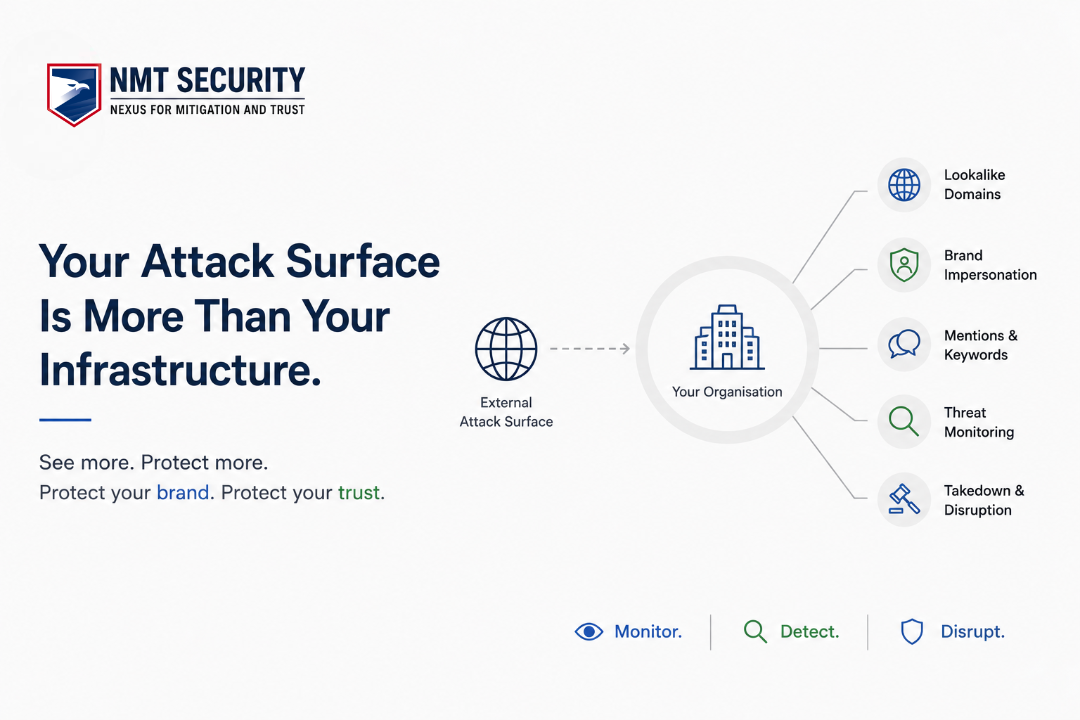
An organisation may have hundreds of legitimate domains, subdomains, applications, and internet-facing assets. But around those assets, an entirely different ecosystem can emerge: lookalike domains, fraudulent websites, impersonating social profiles, fake applications, suspicious mentions, leaked information, phishing infrastructure, and content using the company's identity without permission.
These signals may never appear in a conventional vulnerability scan.
Yet they can still create financial, operational, regulatory, and reputational consequences.
This is where Brand Protection becomes an extension of EASM rather than a separate marketing activity.
The Problem Isn't Finding One Fake Domain
Most organisations can respond when someone sends them a phishing URL.
The harder problem is finding the threats they haven't been told about.
Attackers can register domains before launching campaigns. They can keep infrastructure dormant and activate it when the timing is right. They can change keywords, use different combinations of a brand name, or target different audiences.
A security team waiting for employees or customers to report these threats is already operating behind the attacker.
Continuous monitoring changes the model.
Instead of waiting for someone to discover an impersonation campaign, organisations can monitor for signals associated with their identity and investigate them before they become widespread.
That means monitoring not just domains, but keywords, brand names, executive names, product names, campaign terms, and other identifiers that matter to the organisation.
The objective is not simply to find mentions.
It is to understand which mentions represent risk.
From Monitoring to Threat Intelligence
A single mention of your company online may mean nothing.
A sudden increase in mentions containing a product name, an executive's name, a suspicious domain, and a payment-related keyword is different.
Context changes the risk.
This is where threat monitoring becomes more valuable than simple alerting.
Instead of giving security teams another stream of notifications, the objective should be to identify patterns that indicate an emerging threat.
For example, imagine an organisation launches a new product.
Within days, several domains containing the product name appear. One begins hosting content that resembles the official website. Social media accounts begin using the same branding. Customers start searching for support information using keywords associated with the campaign.
Individually, each signal may appear insignificant.
Together, they may indicate the beginning of an impersonation campaign.
The value of monitoring is not knowing that something exists. It is understanding when something becomes a threat.
Detection Without Takedown Is Only Half the Job
There is another problem.
Finding the threat does not remove it.
A security team may identify a malicious domain, fraudulent page, impersonating profile, or phishing asset and then spend hours coordinating with registrars, hosting providers, platforms, and other intermediaries to have it removed.
During that period, the threat can remain operational.
This creates a gap between detection and disruption.
Effective brand protection therefore needs to move beyond monitoring.
It needs a response mechanism.
When a malicious asset is validated, the organisation should have a structured path to initiate takedown and disruption, reducing the window in which customers, employees, or partners can be exposed.
The objective is simple.
Detect it. Validate it. Disrupt it.
The Executive Risk Is Bigger Than the Security Finding
For security teams, a fake domain may initially look like another technical finding.
For the Board, the implications are different.
What happens if customers enter credentials into a fraudulent website?
What happens if a fake customer-support account convinces users to transfer money?
What happens if a fake recruitment website collects identity documents?
What happens if an impersonated executive causes a supplier to change payment details?
What happens if a fraudulent website begins ranking in search results alongside the legitimate company?
The technical finding is only the starting point.
The actual risk is loss of trust.
That is why external attack surface monitoring increasingly needs to connect technical exposure with business context.
The Outside-In View Is Changing
NMT Security's approach to EASM starts with the same principle:
See what attackers see.
The platform continuously maps external exposure across six lenses: Brand, Application, Network, Email, Public Exposure, and Dark Web, producing an A-F view of external security posture.
That outside-in perspective matters because organisations often have a better understanding of what they own than what the internet says about them.
Attackers see the latter.
- They see the forgotten subdomain.
- The exposed service.
- The leaked credential.
- The lookalike domain.
- The spoofable identity.
- The dark-web mention.
- The public information that can be combined with everything else.
The security challenge is therefore not simply to secure what the organisation knows about.
It is to continuously discover what the outside world knows about the organisation.
Where Brand Protection Fits
Brand Protection extends this visibility beyond infrastructure.
It monitors the digital signals surrounding the organisation's identity, including suspicious domains, impersonation activity, threat mentions, and keywords that may indicate emerging abuse.
For security teams, this creates earlier visibility into threats targeting the organisation's customers and reputation.
For marketing and brand teams, it provides a security mechanism for protecting digital identity.
For legal teams, it creates a structured way to identify potential infringement and abuse.
For leadership, it creates a clearer picture of how the organisation is being represented across the external ecosystem.
The result is a more complete understanding of external risk.
Not just:
"What can attackers access?"
But also:
"What can attackers make the world believe?"
The NMT Security Perspective
At NMT Security, we believe external security cannot stop at identifying exposed infrastructure.
The organisation's digital identity is part of its attack surface.
Through our External Attack Surface Monitor, NMT provides continuous outside-in visibility across Brand, Application, Network, Email, Public Exposure, and Dark Web exposure, helping organisations understand the risks visible from the public internet.
Our approach to Brand Risk Monitoring extends that visibility into the threats surrounding an organisation's identity. This includes monitoring relevant keywords and mentions, identifying potential impersonation and fraudulent activity, and supporting the response process through takedown of malicious assets where appropriate.
The objective is not to generate another list of alerts.
It is to connect threat monitoring, brand protection, external exposure, and response into one continuous view.
NOVA AI adds another layer by correlating EASM, TPRM, GRC, and other risk signals into a prioritised view of what matters most. NMT's underlying risk intelligence model is designed to connect exposure conditions with exploitability, business impact, and changing risk states rather than treating every finding as an isolated alert.
This is where external attack surface management becomes more than asset discovery.
It becomes continuous external risk intelligence.
The Attack Surface Will Keep Expanding
The next generation of cyber attacks will not always begin with a vulnerability.
Some will begin with a domain.
Some with a keyword.
Some with a fake profile.
Some with a fraudulent website.
Some with a leaked credential.
Some with a customer searching for the wrong website.
The organisations that are prepared will not wait for those signals to become incidents.
They will continuously monitor the space around their organisation, understand what is changing, and act before an external threat becomes an internal crisis.
Because cybersecurity is no longer only about protecting the systems you own.
It is about protecting the trust that your organisation has built around them.
More from the blog
See all articles
5 min read
Compliance Is the Baseline. Risk Is the Real Question.
For years, cybersecurity compliance was largely treated as a security function. Policies were documented, controls were tested, evidence was collected and audits were…

6 min read
Compliance Has Stages. The Risk Does Not Wait.
What does compliance really protect you from? The FICCI-EY Risk Survey 2026 found that 61% of respondents identified cyberattacks and data breaches as major financial…

7 min read
Cybersecurity Tool Sprawl: More Detection, Less Direction
There is a point in every organisation's security journey where adding another tool stops solving a security problem and starts creating one. A new endpoint threat leads…

See what Foresee finds on your own domain.
A 30-minute call. Share a domain and we will walk you through what we find.