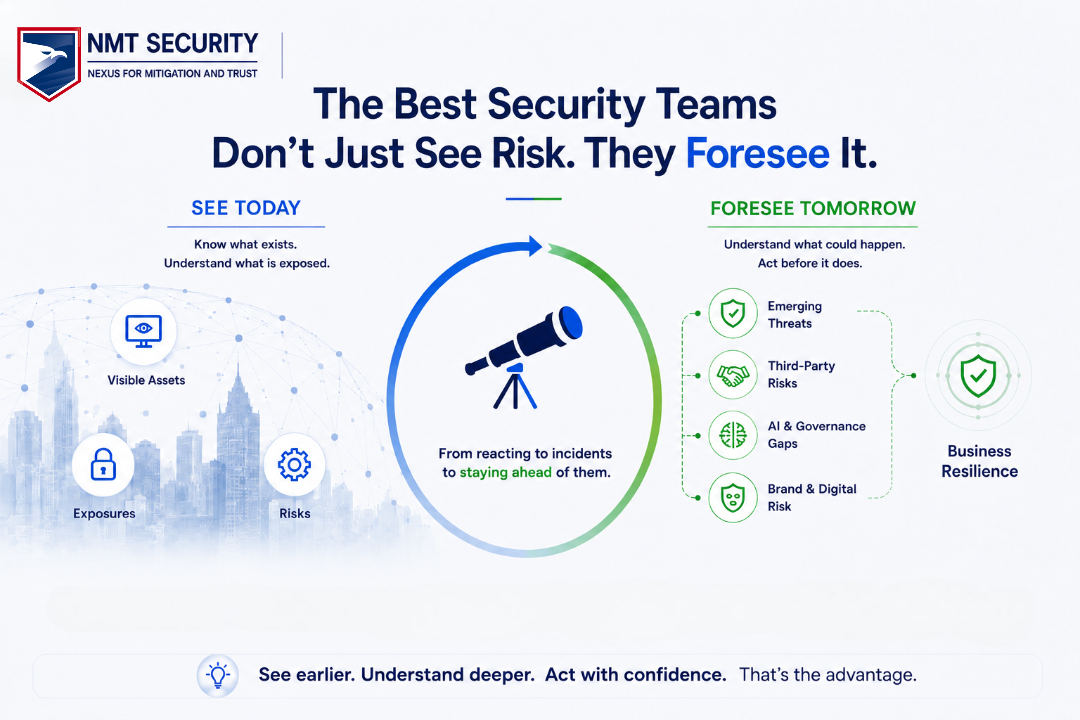
The Best Security Teams Don't Just See Risk. They Foresee It.
3 September 2026 · 6 min read
On this page
- A security company should tell you what it sees
- The name matters more when the platform gets bigger
- Security used to be about reacting faster
- The difference between seeing risk and foreseeing it
- This is where security becomes decision intelligence
- The risks are already moving
- A different question for security leadership
- Where we sit
There is a point in every company's growth where the product becomes bigger than the name on the website.
You start with a name that made sense when there were three people, one product, and a very specific problem you were trying to solve. Then the product expands. New capabilities are added. Customers start using you for problems you did not originally set out to solve. The platform becomes broader, but the name still carries the story of where you started.
That is not necessarily a problem.
Until the name starts describing what you used to do instead of what you actually do.
That is where this gets interesting.
A security company should tell you what it sees
Most security companies are named around one of three things: protection, defence, or technology.
The language makes sense. Security has always been about protecting what you have, defending against what is coming, and deploying technology to keep attackers out.
But the way organisations manage cyber risk has changed.
You cannot protect what you cannot see. You cannot manage what you cannot understand. And you cannot make a good security decision based only on what happened yesterday.
The modern security problem is increasingly about what happens next.
What asset is going to appear tomorrow. Which vulnerability is going to become exploitable. Which vendor is going to introduce risk. Which credential is going to surface. Which AI application is going to be adopted without approval. Which domain is going to be registered by someone trying to impersonate your brand.
The question is no longer only whether your organisation is protected.
It is whether you can foresee the risk before it becomes the problem.
The name matters more when the platform gets bigger
When a company offers one security capability, the name can describe that capability.
But what happens when the platform brings together EASM, TPRM, AI adoption, AI governance, continuous compliance, risk management, brand protection and continuous monitoring?
Calling it a security tool no longer tells the whole story.
Because these capabilities are not really separate problems.
They are different ways of answering the same question:
What could put this organisation at risk next?
- External attack surface monitoring looks at what is visible from outside.
- Third-party risk looks at the organisations you depend on.
- AI governance looks at how new technology is entering the business.
- Continuous Compliance looks at the obligations you are expected to meet.
- Brand monitoring looks at how your identity is being used beyond your control.
- Risk management brings those signals together.
The common thread is not the technology.
It is foresight.
Security used to be about reacting faster
For a long time, security maturity was measured by how quickly an organisation could respond.
- How quickly can you detect an incident.
- How quickly can the SOC investigate it.
- How quickly can you contain it.
- How quickly can you recover.
All of that still matters.
But there is another question that deserves equal attention: how early could you have seen it coming?
A leaked credential does not become dangerous when the attacker uses it. It becomes dangerous when it is exposed.
A vulnerable application does not become a breach when it is exploited. The exposure existed before the exploitation.
A malicious domain does not become a brand crisis when customers complain. It existed before the first customer clicked it.
An unmanaged AI application does not become a governance issue when something goes wrong. The governance gap existed when the application was adopted.
The earlier you can see the condition, the more choices you have.
And that is what foresight changes.
The difference between seeing risk and foreseeing it
Visibility tells you what exists.
Foresight asks what it could become.
That distinction matters.
An exposed application is a technical finding. An exposed application containing sensitive functionality, running outdated software, connected to a critical business process, and visible to an attacker is a business risk.
A leaked credential is a data point. A leaked credential belonging to a privileged user, associated with an active account, and appearing alongside other indicators is a potential attack path.
A new AI tool is an application. An AI tool connected to sensitive organisational data without an approved governance process is a potential compliance, privacy, and security problem.
The value is not in collecting more findings.
It is in understanding what those findings mean.
This is where security becomes decision intelligence
The security industry has spent years producing more alerts, more dashboards and more findings.
The problem is that organisations do not necessarily need more information.
They need better decisions.
A CISO needs to know what should be fixed first.
A CIO needs to understand which technology introduces unacceptable exposure.
A compliance leader needs to know whether documented controls reflect actual conditions.
A third-party risk team needs to know which supplier represents the greatest current exposure.
A Board needs to know where the organisation's most consequential risks are developing.
That requires connecting signals instead of looking at them individually.
It requires moving from "Here are your risks" to "Here is what is changing, why it matters, and what you should do next."
The risks are already moving
The biggest problem with traditional risk assessments is not necessarily that they are wrong.
It is that they become outdated.
An assessment completed in January can be completely accurate in January and still be a poor representation of the organisation in August.
The external attack surface changes.
- Vendors change.
- Technology changes.
- AI adoption changes.
- Threat actors change.
- Regulations change.
- The organisation itself changes.
Risk therefore cannot remain a static document sitting inside a compliance folder.
It has to move with the organisation.
That is why continuous monitoring matters.
And it is why the ability to foresee what is developing becomes more valuable than simply documenting what has already happened.
A different question for security leadership
The traditional security question is:
"Are we secure?"
It is an almost impossible question to answer with certainty.
A better question is:
"What is changing in our risk, and what should we act on before it becomes an incident?"
That question changes the conversation.
It moves security away from a purely defensive function and closer to business decision-making.
It gives leadership a way to understand not just the current state of risk, but the direction in which that risk is moving.
Because knowing where you stand is useful.
Knowing where you are heading is more useful.
Where we sit
At NMT Security, the platform has evolved around a simple idea: organisations need more than protection after something happens. They need visibility into what is happening around them before it becomes a problem.
NOVA AI brings together signals across External Attack Surface Management, Third-Party Risk Management, AI Adoption, AI Governance, Compliance, Brand Risk and continuous monitoring, helping organisations move from disconnected findings towards a prioritised view of risk.
The objective is not to predict the future with certainty.
It is to give security and business leaders enough visibility to recognise what is developing, understand what it could mean, and make a decision while there is still time to act.
That is a very different proposition from simply finding vulnerabilities.
It is about seeing the conditions around a risk before the risk becomes an incident.
And perhaps that is what a security company should ultimately stand for.
Not just protecting what you have.
Not just responding to what happens.
But helping you foresee what could happen next.
Your organisation will always have risk.
The question is whether you discover it after it happens, or see it coming early enough to do something about it.
More from the blog
See all articles
5 min read
Compliance Is the Baseline. Risk Is the Real Question.
For years, cybersecurity compliance was largely treated as a security function. Policies were documented, controls were tested, evidence was collected and audits were…

6 min read
Compliance Has Stages. The Risk Does Not Wait.
What does compliance really protect you from? The FICCI-EY Risk Survey 2026 found that 61% of respondents identified cyberattacks and data breaches as major financial…

7 min read
Cybersecurity Tool Sprawl: More Detection, Less Direction
There is a point in every organisation's security journey where adding another tool stops solving a security problem and starts creating one. A new endpoint threat leads…

See what Foresee finds on your own domain.
A 30-minute call. Share a domain and we will walk you through what we find.