What Is Third-Party Risk Management (TPRM)? A Practical Guide
22 October 2026 · 5 min read
On this page
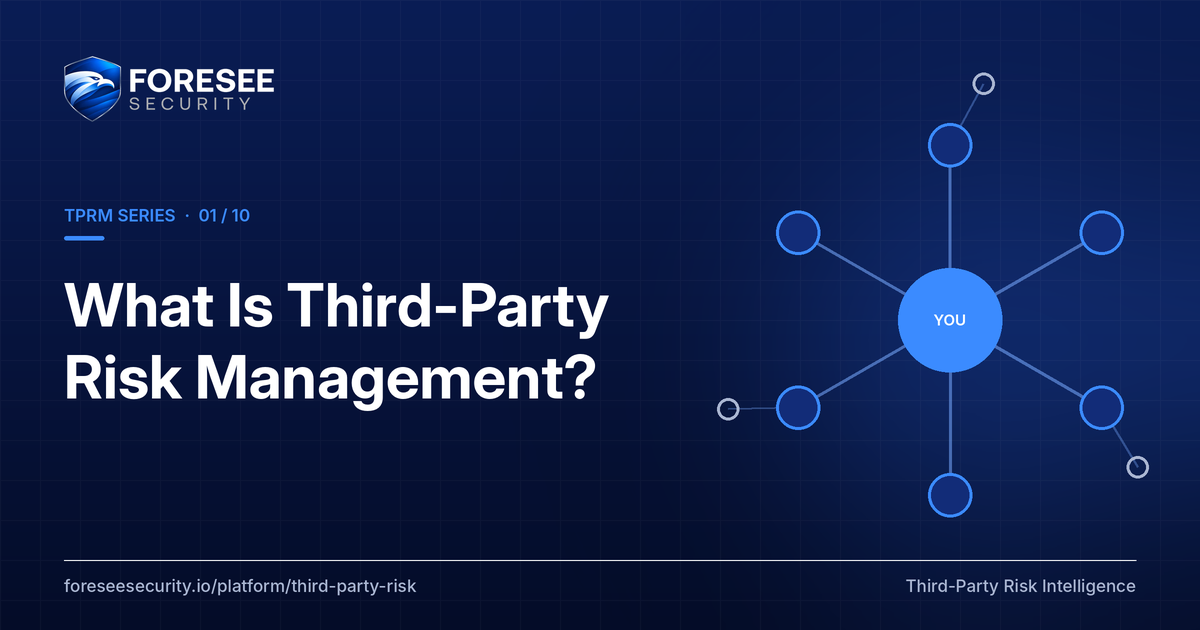
Third-party risk management (TPRM) is how an organisation finds, measures and reduces the risk that comes from outside companies it depends on: vendors, cloud providers, outsourcers, partners, agents and their own suppliers. It matters now more than ever. In Verizon's 2025 Data Breach Investigations Report, the share of breaches involving a third party doubled from 15% to 30% in a single year.
The simplest way to think about it: every vendor that can reach your data, your systems or your customers extends your attack surface. You can outsource the work, but you cannot outsource the accountability. Regulators say this directly. The RBI's IT outsourcing directions hold the regulated entity responsible no matter who runs the service.
What counts as a "third party"
More than most teams list. A typical lending company or bank will have:
- Technology providers: cloud hosting, core banking or loan management systems, SaaS tools, managed SOC.
- Data processors: KYC verification, credit bureaus, payment processors, analytics platforms.
- Customer-facing partners: collection agencies, DSAs, call centres, co-lending partners.
- Back-office services: payroll, HR platforms, legal, audit firms.
- Fourth parties: your vendors' own vendors. Your payment processor's cloud host is your risk too.
[ADD] One line from Nikunj: the vendor nobody thought to list until it caused a problem.
The risks TPRM covers
Cybersecurity gets the attention, but a working program covers several risk types at once:
| Risk type | What it looks like |
|---|---|
| Cybersecurity | A vendor is breached and your data or credentials go with it |
| Data privacy | A processor mishandles personal data you are legally responsible for |
| Operational | A critical vendor goes down and your service stops |
| Regulatory | A vendor's failure puts you out of compliance with RBI, SEBI or DPDP rules |
| Concentration | Too many critical services depend on one provider |
| Reputational | A collections partner's conduct ends up in the news under your name |
| Financial | A vendor becomes insolvent mid-contract |
Why the annual questionnaire model fails
Most TPRM programs still run on a yearly cycle. Send a questionnaire, collect answers, file a rating, repeat next year.
The problem is what happens in between. A vendor can pass its annual review in February, expose a database in April, and nobody on your side sees it until the next February. The questionnaire captured one day. Risk changes every day.
There is a second problem: response rates. Vendors receive dozens of questionnaires from different customers. Without a clear reason and some help, they answer slowly, partly, or not at all.
So a modern program adds two things to the questionnaire:
- Continuous outside-in monitoring. Watch each vendor's external exposure, leaked credentials, breach disclosures and security posture between assessments.
- Event-triggered reassessment. When a vendor appears in a breach disclosure, reassess now, not at the next annual cycle.
This is the gap Foresee's Third-Party Risk Intelligence is built for. It monitors every vendor continuously across six areas, starts a reassessment automatically when a vendor is breached, and has a team that helps vendors answer and fix.
The six areas are brand, applications, network, email, public exposure and the dark web. Each vendor gets an A–F grade in each area, and every finding is linked to what that vendor can reach in your business.
In practice, this is what moves a program from audit-driven to continuous. One Indian NBFC with a growing network of outsourced technology partners used Foresee to replace point-in-time vendor reviews with continuous oversight, and made cyber risk a standing quarterly board topic. Read the NBFC case study.
The core components of a TPRM program
Every program, however mature, needs the same building blocks:
- A complete vendor inventory. You can't manage what isn't on the list.
- Tiering by access and criticality. A payments processor holding card data and an office cleaning contractor don't deserve the same scrutiny.
- Due diligence before onboarding. Check the vendor before you sign.
- Risk assessment scaled to the tier.
- Contract controls: audit rights, breach notification timelines, data handling and exit terms.
- Ongoing monitoring between assessments.
- Remediation tracking until findings are actually closed.
- Reporting to management, the board and regulators.
- Offboarding: revoke access and confirm data return or deletion.
We cover each of these in more depth across this series. Start with the TPRM lifecycle and how to build a TPRM framework.
What regulators expect in India and abroad
TPRM is no longer optional for regulated firms.
- RBI: The Master Direction on Outsourcing of IT Services came into effect on 1 October 2023. It applies to banks, NBFCs and other regulated entities, and requires a board-approved IT outsourcing policy and a risk management framework for outsourcing.
- SEBI: The Cybersecurity and Cyber Resilience Framework (CSCRF), issued in August 2024, requires regulated entities to assess and manage the cyber readiness of their vendors.
- DPDP: Under the DPDP Act and the Rules notified in November 2025, data fiduciaries stay responsible for the processors they engage, and must bind them by contract.
- Outside India: DORA in the EU, the US interagency third-party guidance and NYDFS Part 500 all push in the same direction: continuous oversight, not annual paperwork.
Where to start
If your program is new or stuck, don't start with a 300-question template. Start here:
- Build the vendor list from finance (who do we pay?) and IT (who has access?).
- Mark the 10 to 20 vendors that can reach critical data or stop critical services.
- Check those vendors' external exposure first. That tells you where to spend your assessment effort.
You can test step 3 today. Foresee's free vendor snapshot shows how exposed five of your vendors are, at no cost.
The snapshot uses only passive, public data, so your vendors are never contacted or scanned. Each vendor is graded A–F across the six areas, with its top finding and the questions to ask it. The report arrives within five working days.
FAQs
What is the main goal of third-party risk management? To make sure the vendors you depend on don't cause a breach, outage or compliance failure you are accountable for. TPRM does this by assessing vendors before onboarding, monitoring them during the relationship and removing their access at the end.
Is TPRM only for large enterprises? No. Smaller firms often depend more heavily on vendors because they outsource more. Regulators also apply TPRM rules by entity type, not company size. An NBFC with 200 staff is covered by the same RBI outsourcing directions as a large one.
How often should vendors be assessed? Critical vendors at least annually, with continuous monitoring in between and a reassessment whenever something material changes, such as a breach, an acquisition or a new data flow. Low-risk vendors can go longer.
What's the difference between TPRM and vendor risk management? Vendor risk management covers suppliers you buy from. TPRM is broader and includes partners, agents, affiliates and fourth parties. See TPRM vs vendor risk management.
Do vendors need to install anything for continuous monitoring? Not with outside-in monitoring. It works from publicly observable signals. Vendors only respond to the assessments you send.
See your riskiest vendors first. Book a demo of Foresee Third-Party Risk and we'll rank a sample of your vendors on the call.
Sources: Verizon 2025 DBIR · RBI Master Direction on Outsourcing of IT Services · DPDP Rules 2025 overview, Hogan Lovells
More from the blog
See all articles
2 min read
Introducing Foresee Security: A New Name for the Future of Cybersecurity
NMT Security is becoming Foresee Security. Our name is evolving to reflect a clearer vision: helping organisations understand risk before it impacts their business.…
5 min read
Compliance Is the Baseline. Risk Is the Real Question.
For years, cybersecurity compliance was largely treated as a security function. Policies were documented, controls were tested, evidence was collected and audits were…
6 min read
Compliance Has Stages. The Risk Does Not Wait.
What does compliance really protect you from? The FICCI-EY Risk Survey 2026 found that 61% of respondents identified cyberattacks and data breaches as major financial…

See what Foresee finds on your own domain.
A 30-minute call. Share a domain and we will walk you through what we find.