Security Risk Management: From Hundreds of Findings to the Five That Matter
12 November 2026 · 5 min read
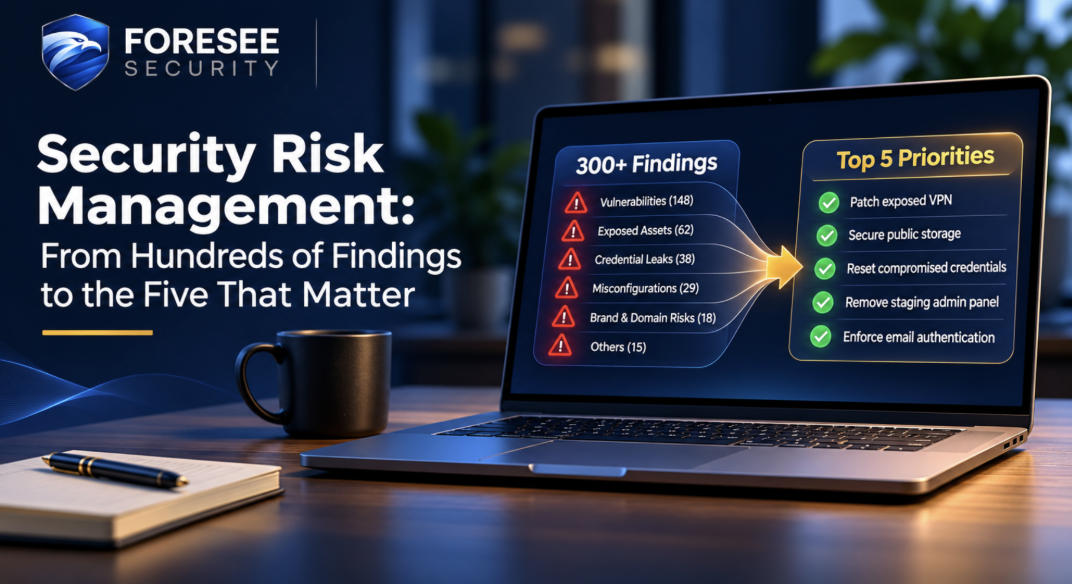
Most security teams don’t have a detection problem. They have a decision problem. By Monday morning, the vulnerability scanner has a backlog, the attack surface tool has new exposures and the dark web feed has another set of alerts. The question is not what the tools found. It is what the team should do first.
A scanner can flag an outdated server. It cannot, on its own, tell you whether that server supports a critical customer service, whether attackers can reach it or whether another alert makes the exposure more urgent. Those details change the decision.
Good security risk management brings those pieces together, makes a call and revisits it when the facts change.
Why more findings can make you less safe
A security review can quickly become a discussion about counts: how many critical findings, how many medium ones, how many tickets closed. Those figures help manage workload, but they do not tell you whether the team is reducing meaningful risk.
The problem is not the size of the backlog by itself. It is the time spent working through it without a clear order.
Want to understand which external exposures deserve attention first? Explore Foresee Security: https://foreseesecurity.io/book-a-demo
A severity score does not tell you what to fix first
CVSS is useful, and I would not suggest ignoring it. But the base score describes technical severity, not the complete business decision. It does not, by itself, establish whether exploitation is happening today, whether an affected system is reachable or how important that system is to your operations.
Consider a critical flaw on a segregated test machine and a medium-severity weakness on a customer login service. The critical finding may still need fixing, but the login service deserves a closer look before anyone decides the order.
CISA’s Known Exploited Vulnerabilities catalog helps identify flaws already exploited in the wild. FIRST’s EPSS estimates the probability of exploitation in the next 30 days. They are useful signals, not substitutes for understanding the asset and its controls.
Five questions that identify the risks that matter
1. Can an attacker reach it? Consider internet exposure, internal access and realistic attack paths.
2. Is exploitation likely or observed? Check KEV, EPSS, public exploits and relevant threat intelligence.
3. What would the business lose? Look at sensitive data, payments, critical operations, privileged access and regulatory consequences.
4. How do the findings connect? Link assets, identities, domains and infrastructure, while distinguishing evidence from assumptions.
5. What happens if we wait? Consider urgency, existing controls and the consequences of delaying action.
Use these questions to rank risk. Then consider remediation effort, dependencies and team capacity to schedule the work. A quick fix is not automatically the highest risk.
What a top-five priority list looks like
Take a hypothetical mid-sized lender with more than 300 open findings. Its security team cannot fix everything this week. After checking exposure, exploitation evidence and the systems involved, it agrees on five actions:
| Finding | Immediate action |
| Internet-facing VPN with a KEV-listed flaw | Investigate possible compromise; mitigate and patch urgently. |
| Public storage containing sensitive information | Restrict access and review access history. |
| Exposed active credentials and suspicious impersonation signals | Revoke sessions, reset credentials and investigate whether the signals are related. |
| Forgotten staging admin panel exposed externally | Restrict access and confirm ownership. |
| Weak DMARC enforcement during brand impersonation attempts | Validate SPF/DKIM alignment and plan enforcement. |
Illustrative example only. The actual order depends on business impact, controls and evidence of compromise.
The remaining findings stay in the backlog, with owners and review dates. Some will move up as new information arrives. The shortlist is a decision about this week, not permission to ignore everything else.
Why connected findings change the decision
A leaked password shows up in one system. A newly registered lookalike domain appears in another. Elsewhere, an exposed login page has no MFA. That does not prove a coordinated attack. But if the same identities or infrastructure connect the findings, the team has a reason to investigate them together.
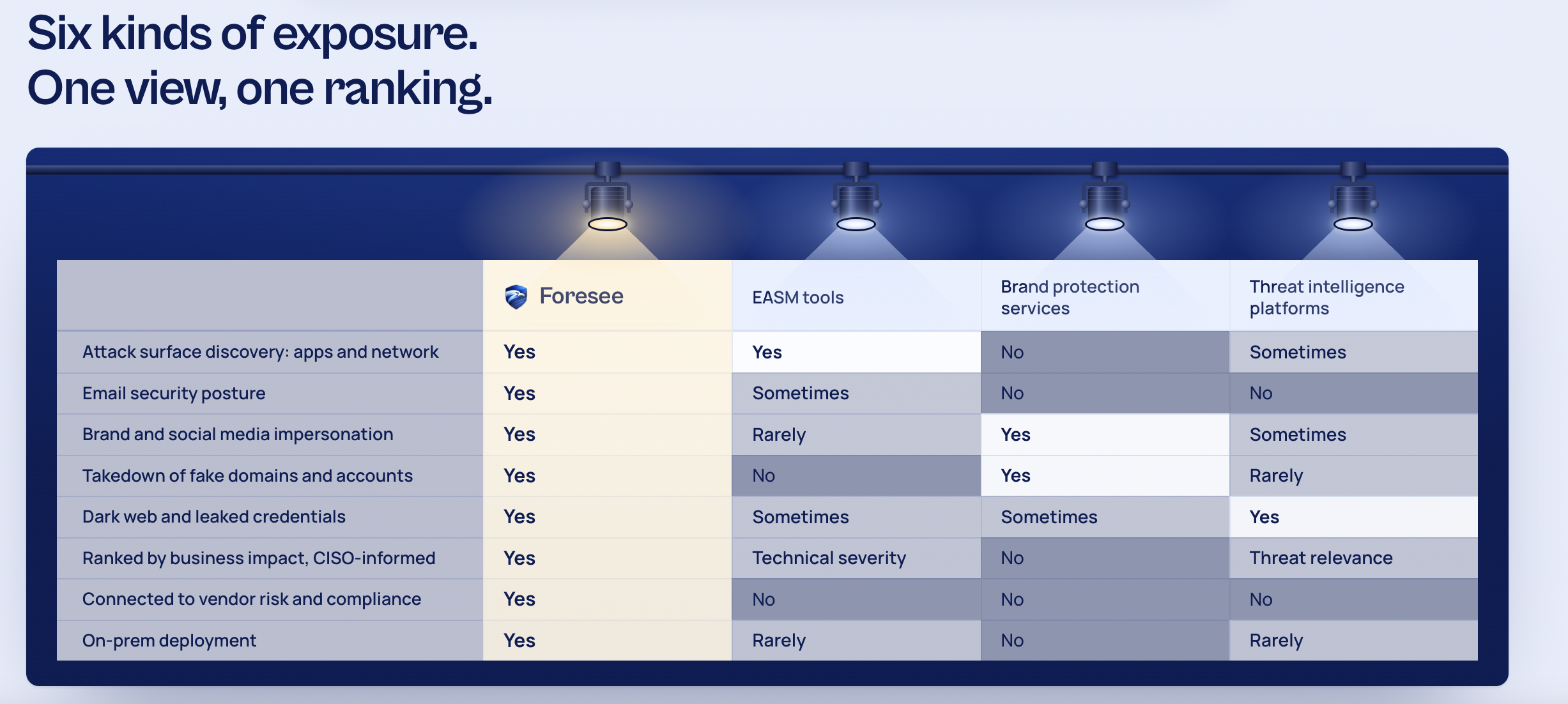
Foresee AI is designed to support that decision. Foresee Security brings together external exposure, third-party risk, compliance context and relevant signals from integrated tools. Connecting findings to assets and business context helps teams investigate possible relationships, understand why an issue matters and decide what to do next. Suspected links still need validation; correlation is not proof of an attack.
A useful output should let an analyst explain three things without opening five different consoles: what needs attention, why it matters and what should happen next.
For more on connecting external signals, read: https://foreseesecurity.io/blogs/85/why-brand-monitoring-and-attack-surface-tools-should-be-one-platform/
How to start this week
Bring findings together. Export open issues and map them to assets or identities.
Add business context. Identify critical systems, sensitive information and compensating controls.
Check exploitation intelligence. Review relevant CVEs against KEV, EPSS and current threat reports.
Look for relationships. Group signals by assets, accounts and domains, and validate suspected links.
Assign immediate actions. Choose a manageable shortlist, set owners and deadlines, and review it weekly or sooner when urgent evidence emerges.
Five is a useful starting point for a small team, not a universal limit. The goal is to make sure material risks receive attention and each action has an owner.
The decision is the value
Closing 50 low-impact tickets may look productive. Investigating one exposed VPN with evidence of exploitation may protect the business far more. Both activities matter, but the dashboard should not confuse volume of work with reduction in risk.
The point is not to arrive at exactly five findings. It is to leave the meeting knowing which risks matter, what evidence supports the decision and who will act next.
FAQs
What is security risk management? The ongoing process of identifying, assessing, treating and monitoring security risks in the context of business impact.
Is CVSS enough to prioritize vulnerabilities? No. Combine severity with exposure, exploitation intelligence, asset importance and existing controls.
How is it different from vulnerability management? Vulnerability management focuses on technical weaknesses; security risk management also considers threats, identities, suppliers and business consequences.
How many findings should a team tackle at once? As many urgent priorities as it can responsibly own and execute. Five is a practical weekly shortlist for some small teams.
How often should priorities change? Review regularly, at least weekly for many teams, and immediately when significant new threats or exposures emerge.
See which risks matter most to your business
Foresee Security connects external exposure, third-party risk, compliance and other security signals to help teams decide what to investigate and fix first. See the platform in action: https://foreseesecurity.io/book-a-demo
Sources
CISA KEV: https://www.cisa.gov/known-exploited-vulnerabilities-catalog
FIRST EPSS: https://www.first.org/epss/
FIRST CVSS: https://www.first.org/cvss/
NIST SP 800-40 Rev. 4: https://csrc.nist.gov/pubs/sp/800/40/r4/final
About the author
Nikunj Mathur is Founder and CEO of Foresee Security. He writes about practical cyber risk decisions for organizations managing complex security environments with limited resources.
LinkedIn: https://www.linkedin.com/in/nikunjmathur/
More from the blog
See all articles
4 min read
12 TPRM Metrics and KPIs to Track Program Performance
The best TPRM metrics measure exposure, not activity. "Assessments completed this quarter" tells the board your team was busy. "Critical vendors with a high-severity…
4 min read
How to Build a Third-Party Risk Management Framework
A TPRM framework is the set of rules that decides, for every third party, how much scrutiny it gets, who signs off and what happens when something goes wrong. The most…
8 min read
Your Attack Surface Never Sleeps. Why Continuous External Exposure Monitoring Is the Need of the Hour
From forgotten subdomains and exposed services to impersonating domains and leaked credentials, organisations need to know what the internet can see before attackers…

See what Foresee finds on your own domain.
A 30-minute call. Share a domain and we will walk you through what we find.