Your Attack Surface Never Sleeps. Why Continuous External Exposure Monitoring Is the Need of the Hour
20 November 2026 · 8 min read
On this page
- The perimeter has changed. Has your security strategy?
- What is External Attack Surface Management?
- Why periodic security assessments are no longer enough
- What Foresee Security brings to External Exposure Intelligence
- One unified view instead of disconnected security tools
- From thousands of findings to the decisions that matter
- Continuous monitoring: From periodic snapshots to ongoing awareness
- Who needs External Attack Surface Management?
- The Foresee Security approach
- The question is no longer whether your attack surface will change.
From forgotten subdomains and exposed services to impersonating domains and leaked credentials, organisations need to know what the internet can see before attackers exploit it.
The perimeter has changed. Has your security strategy?
There was a time when organisations could define their security perimeter with reasonable certainty. It consisted of corporate networks, data centres, endpoints, firewalls and applications hosted within a controlled environment.
That perimeter no longer exists in the same form.
Today, organisations operate across cloud environments, SaaS applications, APIs, remote infrastructure, third-party integrations and distributed digital services. New domains and subdomains appear, applications are deployed, certificates expire, services become publicly accessible, and employees' credentials may surface in underground forums.
Every one of these changes can create a new point of exposure.
The challenge is that security teams often discover these exposures through periodic vulnerability assessments, penetration tests, security audits or incident investigations. By then, an attacker may already have discovered and exploited the weakness.
The internet does not wait for your next security assessment. Neither do attackers.
This is why External Attack Surface Management (EASM) is becoming an essential component of modern cybersecurity programmes.
What is External Attack Surface Management?
External Attack Surface Management is the continuous discovery, monitoring, assessment and prioritisation of an organisation's internet-facing assets and exposures.
It answers a fundamental security question:
If an attacker were looking at our organisation from the outside, what could they discover, access, impersonate or exploit?
Unlike traditional security tools that primarily focus on assets already known to the organisation, EASM helps identify assets and exposures that may have been overlooked, forgotten, misconfigured or introduced over time.
A comprehensive EASM programme should look beyond IP addresses and open ports. It should also consider:
- Internet-facing applications, APIs and forgotten subdomains.
- Exposed network services and infrastructure.
- SSL/TLS certificate issues and configuration weaknesses.
- Email security misconfigurations that enable spoofing.
- Lookalike domains and fraudulent websites.
- Social media impersonation and brand abuse.
- Leaked credentials and exposed organisational data.
- Threat intelligence indicating campaigns targeting the organisation's technology stack.
The objective is not simply to produce another list of vulnerabilities. It is to maintain an accurate, continuously updated understanding of an organisation's external exposure.
Why periodic security assessments are no longer enough
A vulnerability assessment conducted today represents a point-in-time view of the environment.
Consider a few scenarios:
1. A forgotten subdomain becomes an entry point
A development team deploys a temporary application on a subdomain. The project is eventually discontinued, but the application remains publicly accessible. It may contain outdated software, weak authentication or an exposed administrative interface.
The organisation may have no record of the application, but an attacker can still find it.
2. A new vulnerability changes the risk overnight
A publicly disclosed vulnerability affects a technology used by the organisation. Threat actors begin scanning the internet for vulnerable instances.
An asset that was considered relatively secure yesterday may become a high-priority exposure today.
3. A fraudulent domain targets customers
An attacker registers a domain that closely resembles the organisation's official website, creates a convincing login page and begins targeting customers.
Traditional vulnerability scanning may never identify this threat because the fraudulent infrastructure does not belong to the organisation.
4. Employee credentials appear in a data leak
Credentials associated with corporate email addresses surface in a public dump or underground marketplace. If the accounts remain active, attackers may attempt account takeover, phishing or credential stuffing.
Without continuous monitoring, the organisation may not discover the exposure until suspicious activity is detected internally.
These are not isolated security problems. They represent different dimensions of the same challenge: an organisation's external risk is constantly evolving.
What Foresee Security brings to External Exposure Intelligence
At Foresee Security, we approach EASM as a broader external exposure intelligence capability.
Our objective is to help organisations understand their digital footprint, identify emerging exposures, assess their significance and take action before they translate into business impact.
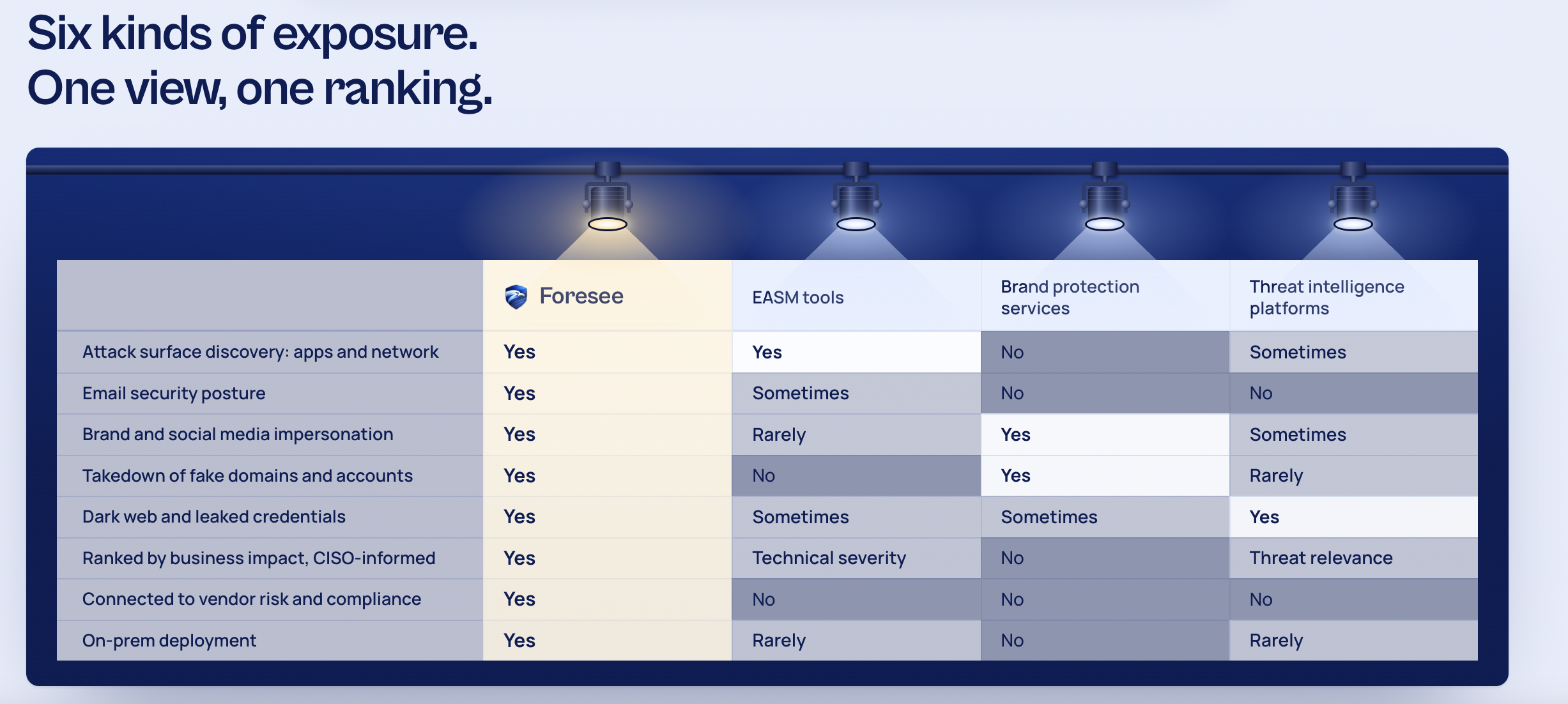
Foresee Security brings multiple external exposure capabilities together in a unified view.
1. Application and domain exposure monitoring
Discover internet-facing applications, subdomains, login portals, APIs and forgotten web assets.
Identify exposed applications and potential weaknesses across the external application footprint.
This helps security teams understand what is publicly accessible, including assets that may not be adequately represented in internal asset inventories.
2. Network and infrastructure exposure
Identify publicly accessible IP addresses, open ports and exposed network services.
Understand which services are reachable from the internet and identify configurations that could increase the organisation's attack surface.
The goal is to provide visibility into infrastructure from the same external perspective an attacker would use.
3. Email security posture monitoring
An organisation's email domain is one of its most important digital identities.
Foresee monitors email security posture, including SPF, DKIM and DMARC-related weaknesses, to identify conditions that could enable domain spoofing and increase phishing risk.
This helps organisations strengthen email authenticity and reduce opportunities for attackers to impersonate their domains.
4. Brand and digital impersonation monitoring
Attackers increasingly target customers, employees and business partners through fake websites, lookalike domains and fraudulent social media profiles.
Foresee monitors suspicious domains, social media impersonation and fraudulent digital identities associated with an organisation.
Where applicable, our brand protection capabilities support takedown requests and remediation of fraudulent domains and accounts.
The objective is to move beyond identifying impersonation to helping organisations address it.
5. Dark web and credential exposure intelligence
Compromised credentials can provide attackers with a shortcut into corporate environments.
Foresee monitors relevant dark web and credential exposure intelligence to help identify leaked organisational credentials and potentially exposed information.
When credentials are discovered, security teams can investigate affected accounts, validate whether they remain active and initiate appropriate remediation.
6. Threat intelligence and emerging attack indicators
Knowing that a vulnerability exists is important. Knowing whether attackers are actively exploiting it is equally important.
Foresee connects threat intelligence with an organisation's observed technology footprint to help identify relevant threats and emerging exposure.
This enables security teams to focus on vulnerabilities and campaigns that are relevant to their actual environment rather than treating every security alert equally.
One unified view instead of disconnected security tools
Many organisations use separate products or services for attack surface discovery, vulnerability monitoring, brand protection, threat intelligence and dark web monitoring.
The result can be fragmented visibility.
One team may know about an exposed application. Another may be monitoring a fraudulent domain. A third may have discovered leaked credentials. Yet these findings may never be connected to provide a complete picture of organisational exposure.
Foresee brings these capabilities together.
The platform provides an overall external exposure view, with A–F security grading across six exposure areas, helping teams understand their posture and track changes over time.
Security teams can review:
- Overall external exposure posture.
- Asset discovery and monitoring.
- Open findings and their severity.
- Changes in exposure over time.
- Remediation progress.
- Fraudulent domains and accounts requiring takedown.
This creates a more consistent way to understand and manage external exposure.
From thousands of findings to the decisions that matter
One of the biggest challenges in cybersecurity is not the absence of security data. It is the volume of findings that security teams are expected to process.
A critical vulnerability on an internet-facing payment application is not equivalent to a low-risk informational finding on an isolated asset.
Similarly, a forgotten login portal without multi-factor authentication, an active lookalike domain and leaked employee credentials may collectively represent a much greater business risk than any one finding considered in isolation.
Foresee AI helps bring this context together.
It analyses findings and helps prioritise remediation based on exposure, severity, relevance and potential business impact.
Instead of simply asking:
"What vulnerabilities do we have?"
Security teams can begin asking:
"Which exposures should we fix first, and why?"
This is an important shift from vulnerability visibility to actionable cyber risk intelligence.
Continuous monitoring: From periodic snapshots to ongoing awareness
Continuous monitoring is what makes external exposure management effective.
An organisation's attack surface can change whenever:
- A new application or subdomain is deployed.
- A cloud service becomes publicly accessible.
- A certificate expires.
- A new vulnerability affects an exposed technology.
- A lookalike domain is registered.
- Credentials are leaked.
- An attacker begins an impersonation campaign.
Waiting for a quarterly assessment to discover these changes creates unnecessary windows of exposure.
A continuous EASM programme helps organisations maintain ongoing visibility, detect changes and initiate remediation workflows as new findings emerge.
It also enables security leaders to measure whether their external security posture is improving or deteriorating over time.
The goal is not to generate more alerts. It is to reduce the time between exposure, discovery, prioritisation and remediation.
Who needs External Attack Surface Management?
EASM is particularly relevant for organisations with complex or rapidly changing digital environments, including:
- Banks, NBFCs and financial services organisations.
- Insurance companies and fintech businesses.
- Healthcare and pharmaceutical organisations.
- Technology companies and SaaS providers.
- Enterprises operating across multiple cloud environments.
- Organisations with extensive third-party and vendor ecosystems.
- Businesses with customer-facing digital platforms.
For regulated organisations, continuous external exposure monitoring can also complement vulnerability management, security governance, risk assessments and regulatory compliance programmes.
The Foresee Security approach
At Foresee Security, we believe that external exposure should not be managed as an isolated technical exercise.
It should be part of a broader cyber risk management strategy.
Our External Exposure Intelligence capability brings together application and network discovery, email security posture, brand monitoring, dark web intelligence, threat intelligence and takedown support.
With AI-driven prioritisation, security teams can move from fragmented findings to informed decisions.
And because Foresee is designed as a connected cyber risk intelligence platform, external exposure insights can also contribute to a broader understanding of third-party risk and continuous compliance.
Organisations can deploy Foresee through cloud or on-premises environments, depending on their requirements.
The objective is simple: know what is exposed, understand why it matters, and act before it becomes a business problem.
The question is no longer whether your attack surface will change.
It will.
The real question is whether your security team will know when it changes.
Continuous External Attack Surface Management is no longer just an additional security capability. It is becoming a foundational requirement for organisations operating in an increasingly connected and exposed digital world.
See your organisation from the outside. Discover what others can see. Fix what matters first.
Explore Foresee Security External Exposure Intelligence:
https://foreseesecurity.io/platform/external-exposure/
Foresee Security
One Platform. Connected Risks. Smarter Decisions.
More from the blog
See all articles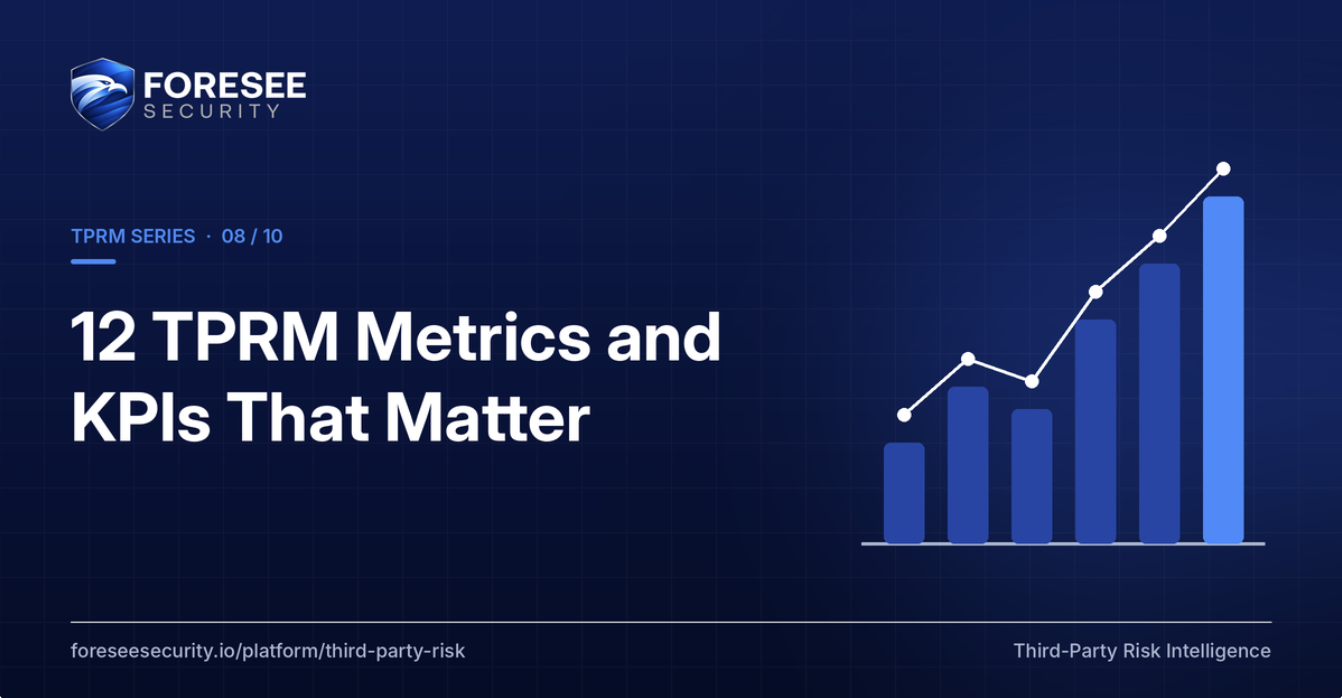
4 min read
12 TPRM Metrics and KPIs to Track Program Performance
The best TPRM metrics measure exposure, not activity. "Assessments completed this quarter" tells the board your team was busy. "Critical vendors with a high-severity…
4 min read
How to Build a Third-Party Risk Management Framework
A TPRM framework is the set of rules that decides, for every third party, how much scrutiny it gets, who signs off and what happens when something goes wrong. The most…
4 min read
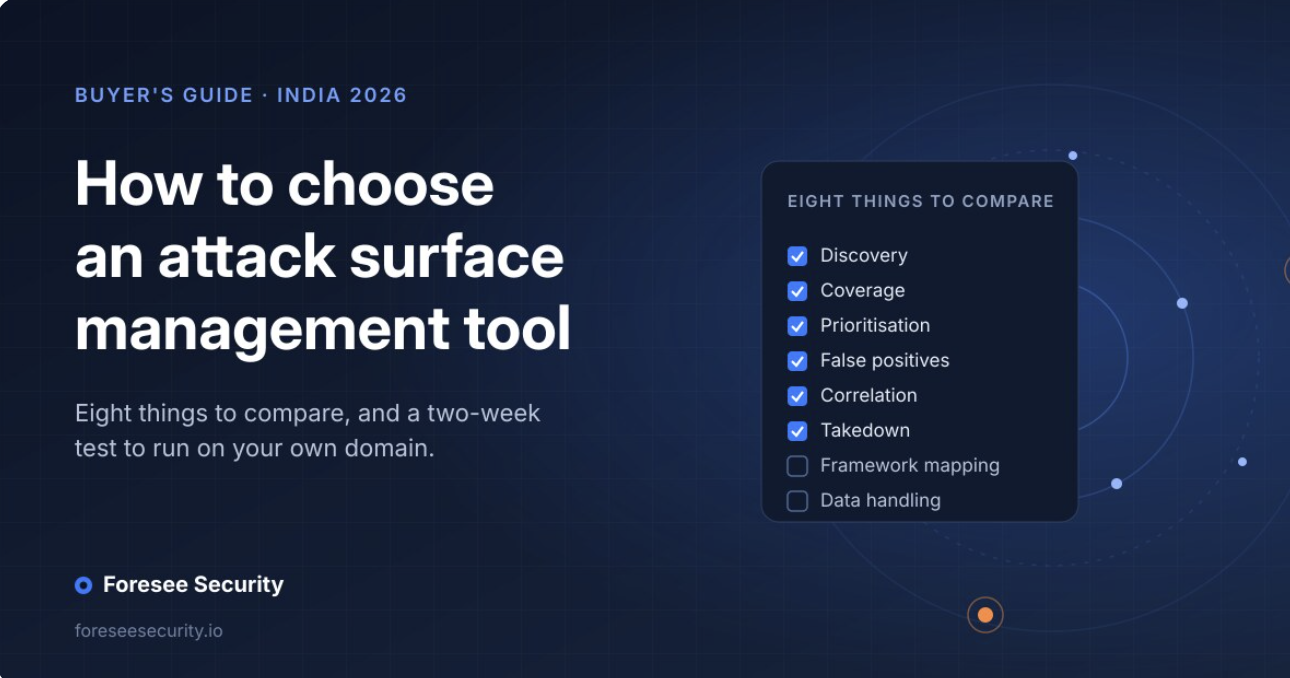
How to Choose an Attack Surface Management Tool in India (2026)
Every attack surface management tool will show you a dashboard full of findings in the demo. That proves nothing. The right tool is the one that finds assets you didn't…

See what Foresee finds on your own domain.
A 30-minute call. Share a domain and we will walk you through what we find.