How to Choose an Attack Surface Management Tool in India (2026)
18 November 2026 · 4 min read
On this page
Every attack surface management tool will show you a dashboard full of findings in the demo. That proves nothing. The right tool is the one that finds assets you didn't know you had, and helps your team fix the few that matter. Here are the eight things to compare, and how to test them on your own domain before you sign.
What attack surface management should do
Attack surface management (ASM) continuously discovers everything you expose to the internet, then watches it for risk. That covers domains and subdomains, web apps and APIs, open ports and services, certificates, email settings and cloud storage. Better tools also watch what attackers use against you from outside your network: lookalike domains, fake social profiles and leaked credentials.
It works from the outside in, so there is nothing to install. That also makes it one of the easiest security tools to test properly before buying.
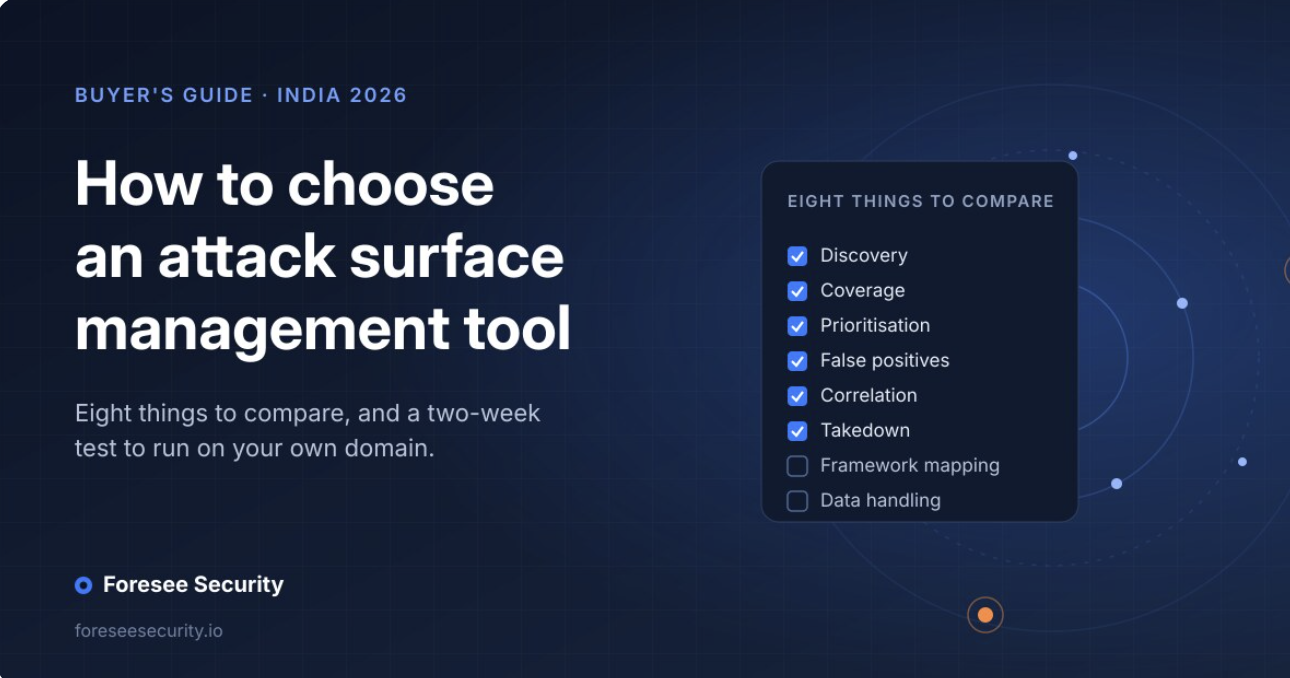
Eight things to compare
| What to compare | Question to ask the vendor | Why it matters |
|---|---|---|
| Discovery | Will you find assets I haven't given you? | Forgotten subdomains and old campaign sites are where most surprises live |
| Coverage | Do you cover brand, email, public exposure and the dark web, or only infrastructure? | Attacks often start with a fake profile or a stolen login, not an open port |
| Prioritisation | How do you decide what I fix first? | A list of 400 findings sorted by severity is a spreadsheet, not a decision |
| False positives | How many findings in a trial turn out to be nothing? | Noise is what makes teams stop reading alerts |
| Correlation | Do you link findings that belong to the same attack? | A leaked password plus a phishing domain is one incident, not two tickets |
| Takedown | Can you take down fake profiles and domains, or only alert? | An alert without action just tells you that you're losing |
| Framework mapping | Are findings mapped to MITRE ATT&CK? | It lets your SOC compare tools on the same yardstick |
| Data handling | Where is my data stored, and who can access it? | Under DPDP, your vendor's security is your problem too |
Want to run this test on your own domain? Share a domain and we'll show you what we find.
How to run a fair trial
- Give every vendor the same one domain and nothing else. See who finds the most real assets on their own.
- Run them side by side for two weeks. Outside-in tools don't interfere with each other.
- Count the findings your team would actually act on, not the total. Mark everything else as noise.
- Ask each vendor for their top five. Compare those lists. That is where the real difference shows.
- Check one finding end to end. How long from alert to an owner, a fix and proof it is closed?
The most common buying mistake is choosing the tool with the biggest number in the demo. More findings feels like more security. Six months later the team has stopped opening the dashboard, because nobody has time to sort 400 alerts, and the renewal goes through anyway because switching feels like more work.
What changes for Indian buyers
Three things matter more here than in a global buyer's guide. DPDP makes data handling a selection criterion, not a footnote. RBI, SEBI and IRDAI-regulated companies need evidence they can show an auditor. And many mid-sized teams have two or three people covering all of security, so a tool that needs a full-time analyst to run it won't get used.
A two-person team doesn't need more data. It needs a short list it trusts, with the fix written next to each item, and alerts quiet enough that a real one still gets read.
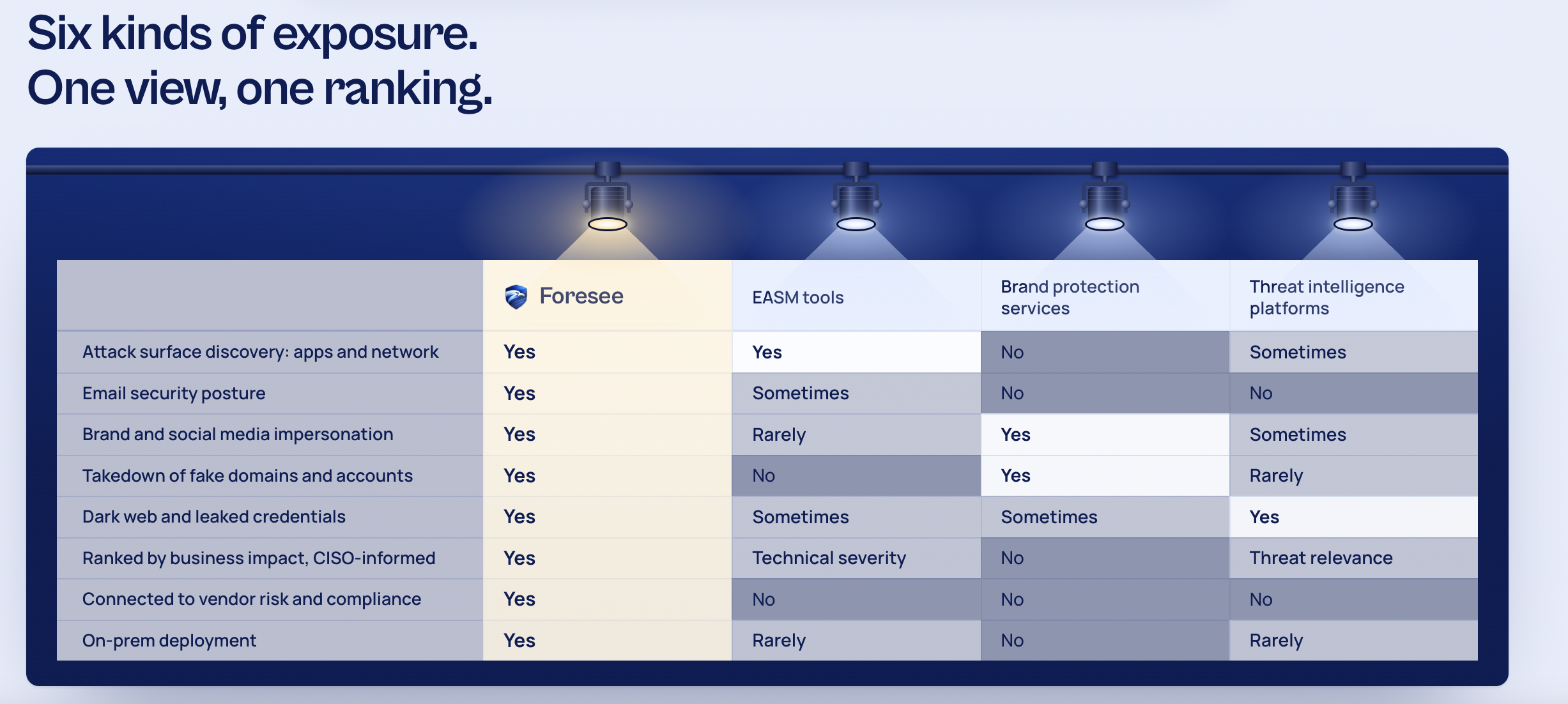
Foresee's External Exposure module was built for that team. It covers brand, applications, network, email, public exposure and the dark web in one view, supports takedowns, and maps findings to MITRE ATT&CK. Foresee AI turns the findings into a short, ranked list. If you're replacing more than one tool, read Cybersecurity Tool Sprawl: More Detection, Less Direction.
FAQs
What is attack surface management?
The continuous discovery and monitoring of everything an organisation exposes to the internet, so risks are found and fixed before attackers use them.
How is ASM different from vulnerability scanning?
A scanner checks the assets you point it at. ASM first finds the assets, including ones you didn't know about, then keeps watching them.
How long should an ASM trial run?
Two weeks is enough to compare discovery, noise and prioritisation on the same domain.
Compare us on your own domain.
Book a demo Explore External Exposure
About the author
Nikunj Mathur
Founder and CEO, Foresee Security
Nikunj is the founder and CEO of Foresee Security and a practising CISO in financial services, where he runs security for a regulated NBFC. He writes about how mid-sized companies make cyber risk decisions with small teams. Before Foresee, he co-founded Urban Terrain, a bicycle brand that was later acquired. He holds a B.Tech in Computer Science.
More from the blog
See all articles
4 min read
12 TPRM Metrics and KPIs to Track Program Performance
The best TPRM metrics measure exposure, not activity. "Assessments completed this quarter" tells the board your team was busy. "Critical vendors with a high-severity…
4 min read
How to Build a Third-Party Risk Management Framework
A TPRM framework is the set of rules that decides, for every third party, how much scrutiny it gets, who signs off and what happens when something goes wrong. The most…
8 min read
Your Attack Surface Never Sleeps. Why Continuous External Exposure Monitoring Is the Need of the Hour
From forgotten subdomains and exposed services to impersonating domains and leaked credentials, organisations need to know what the internet can see before attackers…

See what Foresee finds on your own domain.
A 30-minute call. Share a domain and we will walk you through what we find.