How to Build a Third-Party Risk Management Framework
23 November 2026 · 4 min read
On this page
A TPRM framework is the set of rules that decides, for every third party, how much scrutiny it gets, who signs off and what happens when something goes wrong. The most common mistake is starting with the questionnaire. Start with the tiering model instead. Get that right and every later decision is easier to defend to an auditor.
This guide walks through eight building blocks and a realistic 90-day plan. If you're new to the topic, read what is TPRM first.
1. Set governance and risk appetite
Decide who owns third-party risk and how much of it the organisation will accept. In regulated firms this has to reach the board. The RBI's IT outsourcing directions require a board-approved outsourcing policy and a risk management framework for outsourcing arrangements.
Write down:
- Who owns the framework (usually the CISO or CRO)
- Who can approve a high-risk vendor, and who can approve an exception
- What risk levels need board or committee visibility
For a full breakdown, see TPRM roles and responsibilities.
2. Build the inventory
Combine three lists: who finance pays, who IT has granted access to, and who the business shares customer data with. Expect the combined list to be longer than any single one. For each third party, record the service, the business owner, the data it touches, the systems it reaches and the contract dates.
3. Design the tiering model
Tiering decides everything downstream, so make it simple and based on facts you can check. Two questions do most of the work:
- What can the vendor reach? Customer personal data, payment data, production systems, internal network, nothing sensitive.
- What happens if the vendor fails? A regulated service stops, a key business process stops, minor inconvenience.
| Fails: regulated service stops | Fails: business process stops | Fails: minor impact | |
|---|---|---|---|
| Reaches critical data or systems | Critical | Critical | High |
| Reaches internal data | High | High | Medium |
| Reaches nothing sensitive | Medium | Low | Low |
Adjust the labels to your business, but keep the logic visible. An auditor should be able to see why a vendor landed in its tier.
4. Define control expectations per tier
Map what you expect from vendors to a standard you already use, so you're not inventing controls. ISO 27001:2022 covers supplier relationships in Annex A controls 5.19 to 5.23, including cloud services. Many Indian regulated entities also need to show alignment with SEBI's CSCRF or RBI's directions.
For each tier, define the minimum: certifications accepted, evidence required, contract clauses mandatory.
5. Choose the assessment method
Use different depth for each tier. Critical vendors get a full questionnaire with evidence and possibly an audit. Medium vendors get a short questionnaire or a certificate review. Low-tier vendors get an inventory record.
Two practical rules help:
- Accept existing evidence (SOC 2 reports, ISO certificates, pooled audit results) before asking for custom answers. RBI's directions explicitly permit pooled audits of a shared service provider.
- Check external exposure first. It tells you what to ask about.
6. Set up continuous monitoring
Assessments are snapshots. Monitoring covers the time between them. At minimum, monitor critical and high-tier vendors for external exposure, breach disclosures, leaked credentials and email and domain security. Define what event triggers a reassessment.
Foresee's Third-Party Risk Intelligence runs this as a five-step loop: onboard and tier, assess, monitor, remediate, report. Monitoring covers six areas for every vendor, and a breach disclosure starts a reassessment automatically.
7. Handle remediation and exceptions
Every finding needs an owner, a due date and an escalation path. Every exception (a vendor you keep despite a known gap) needs a named approver, compensating controls and an expiry date. Exceptions without expiry dates become permanent.
[ADD] Nikunj: one rule about exceptions learned the hard way.
8. Report to management and the board
Pick a small set of metrics and report them on a fixed schedule. Our list of 12 TPRM metrics and KPIs is a good place to choose from. Regulators increasingly ask for vendor oversight records, so keep evidence of every assessment, finding and decision.
Here's what this looks like in a real program. An Indian NBFC working with Foresee standardised its RBI Master Direction and ISO 27001 controls across systems and teams, replaced audit-cycle vendor reviews with continuous TPRM, and set up quarterly board risk reviews. It did this with fractional CISO support rather than a full-time hire. See the NBFC case study.
A realistic 90-day plan
| Weeks | Focus | Output |
|---|---|---|
| 1–2 | Governance | Owner named, policy drafted, approval route agreed |
| 3–5 | Inventory | Combined third-party list with owners and data access |
| 6–7 | Tiering | Every vendor tiered; critical list agreed with the business |
| 8–10 | Critical vendors | External exposure checked, assessments sent, contract gaps listed |
| 11–12 | Monitoring and reporting | Monitoring live for critical and high tiers; first board report |
FAQs
What is a TPRM framework? The documented structure for managing third-party risk: governance, tiering, control standards, assessment methods, monitoring, remediation and reporting.
Which standard should a TPRM framework follow? Use what your organisation already follows. ISO 27001 supplier controls are common. Regulated Indian firms also map to RBI's outsourcing directions or SEBI's CSCRF.
How is a framework different from a policy? The policy states the rules and gets approved. The framework is the full operating model that puts those rules into practice. See TPRM policy requirements.
How long does it take to build a TPRM framework? A working first version takes about three months for a mid-sized firm. Maturity takes longer.
Start with your critical vendors. Book a demo of Foresee Third-Party Risk and bring your vendor list. We'll rank a sample on the call.
Sources: RBI Master Direction on Outsourcing of IT Services · Nishith Desai Associates on RBI IT outsourcing directions · ISO 27001 supplier controls under SEBI CSCRF, TCSA
About the author: Nikunj Mathur is Founder and CEO of Foresee Security and a practising CISO in financial services. He writes about how mid-sized companies make cyber risk decisions with small teams.
More from the blog
See all articles
4 min read
12 TPRM Metrics and KPIs to Track Program Performance
The best TPRM metrics measure exposure, not activity. "Assessments completed this quarter" tells the board your team was busy. "Critical vendors with a high-severity…
8 min read
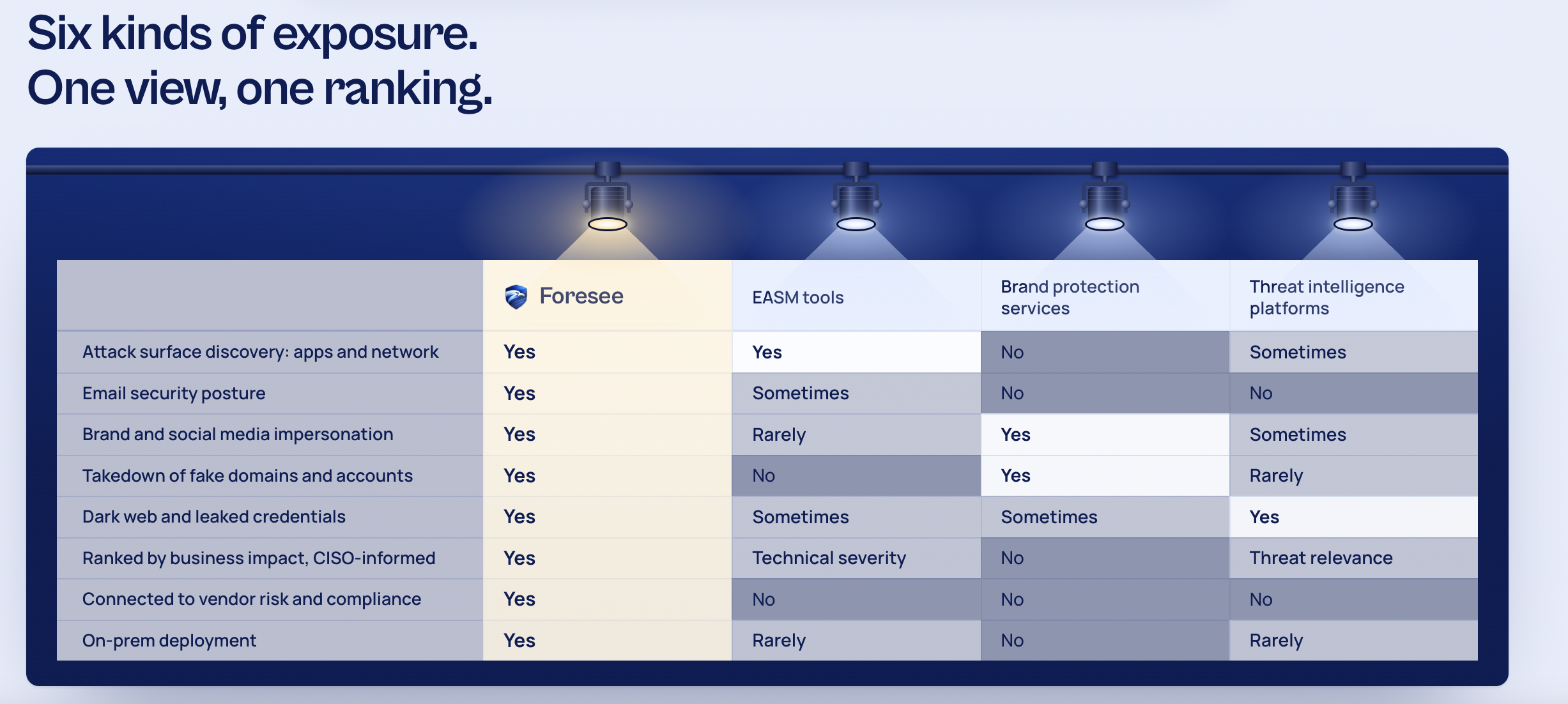
Your Attack Surface Never Sleeps. Why Continuous External Exposure Monitoring Is the Need of the Hour
From forgotten subdomains and exposed services to impersonating domains and leaked credentials, organisations need to know what the internet can see before attackers…
4 min read
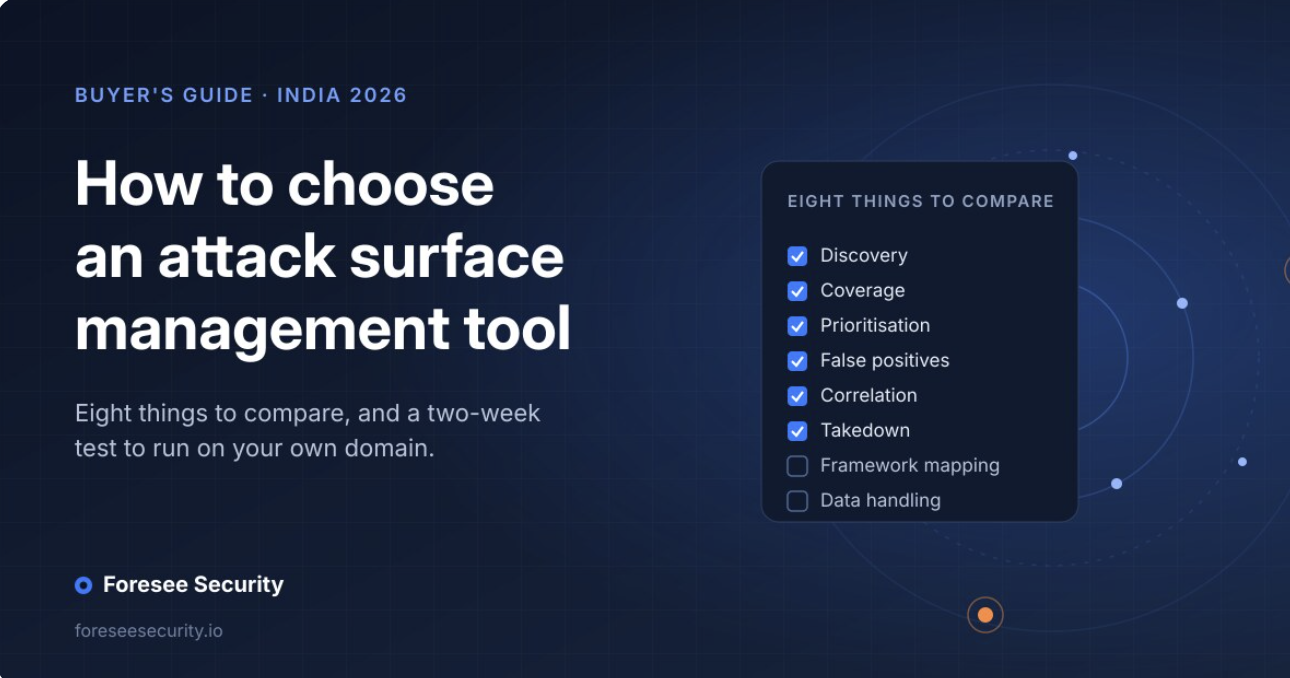
How to Choose an Attack Surface Management Tool in India (2026)
Every attack surface management tool will show you a dashboard full of findings in the demo. That proves nothing. The right tool is the one that finds assets you didn't…

See what Foresee finds on your own domain.
A 30-minute call. Share a domain and we will walk you through what we find.