Security Ratings vs Attack Surface Management: Which Do You Need?
16 November 2026 · 9 min read
On this page
- What a security rating is
- How a security rating is built
- Five reasons your score may be wrong
- What attack surface management is
- How attack surface management works
- Side by side
- Example: one company, two views
- Which one do you need?
- How to use ratings and ASM together
- How to correct and improve your score
- What to ask before you pay for a rating
- Using security ratings to judge your vendors
- Key terms
- FAQs
A security rating tells you how you look from the outside. Attack surface management tells you what to fix. Many companies buy the first and expect the second. If your score went down last quarter and nobody could explain why, this post is for you. It covers how ratings are built, why they are often wrong, how attack surface management differs, how to use the two together, and how to use ratings when judging your vendors.
What a security rating is
A security rating is a single score, often a letter or a number out of 100, built from what a vendor can observe about you on the internet: open ports, patching signals, email settings, certificates, leaked credentials. Buyers, partners and insurers use it to judge you quickly, often before they speak to you.
The score is useful as a headline. It is a poor work plan. It compresses hundreds of observations into one number, and the number doesn't say which observation to fix first, or whether it is even yours.
How a security rating is built
Every rating vendor uses its own model, but most follow the same three steps.
- Attribution. The vendor decides which domains, IP ranges and cloud assets belong to you. This step is automated and often wrong.
- Observation. It scans those assets and collects outside signals across categories such as:
| Category | What is observed |
|---|---|
| Network security | Open ports, exposed services, risky protocols |
| Patching | Software versions visible from outside, known vulnerabilities |
| Email and DNS | SPF, DKIM, DMARC, DNS configuration |
| Application security | Certificates, TLS settings, web headers |
| Leaked credentials | Employee logins found in breach data |
| Threat signals | Mentions on forums, malware traffic linked to your IPs |
- Scoring. Each category is weighted and rolled into one number. The weights are the vendor's, and they rarely match what matters most to your business.
Five reasons your score may be wrong
- Assets that aren't yours. Shared hosting, CDN addresses, or a business unit you sold years ago, still counted against you.
- Old findings. A fixed issue still shows until the vendor rescans.
- Missing assets. The forgotten subdomain the vendor didn't attribute to you won't hurt your score, but an attacker will still find it.
- Invisible controls. MFA, network segmentation and monitoring don't show from outside, so the score can't credit them.
- One heavy issue. A single expired certificate on a minor site can pull a category down more than it deserves.
Reasons 1 and 2 make the score look worse than reality. Reason 3 makes it look better. That last one is the dangerous one.
What attack surface management is
Attack surface management (ASM) discovers every asset you expose, watches each one continuously, and turns what it finds into a list of fixes. Where a rating answers "how do we compare?", ASM answers "what do we do on Monday?"
How attack surface management works
ASM runs as a continuous cycle, not a one-off report:
- Discover. Starting from your main domain, it finds every related asset: subdomains, IP ranges, cloud services, web apps, login pages, email domains, and social profiles that use your brand.
- Inventory. Each asset is recorded with what runs on it, when it was first seen and, ideally, who owns it.
- Monitor. Every asset is checked daily for new exposures: an opened port, an expired certificate, a known exploited vulnerability, a leaked password, a lookalike domain.
- Prioritise. Findings are ranked by how reachable, how exploited and how important they are, not by severity alone.
- Fix and verify. Each finding gets an owner and a fix, and the platform confirms when it is closed.
The output is a short, current list of what to do, not a score.
Side by side
| Security rating | Attack surface management | |
|---|---|---|
| Main output | One score | A ranked list of findings with fixes |
| Who it is for | Buyers, insurers, the board | The security team |
| Asset discovery | The vendor's view, which you can dispute | Continuous, including assets you forgot |
| Brand and dark web | Sometimes, as score inputs | Fake profiles, lookalike domains and leaked logins as findings to act on |
| Speed | Changes when the vendor rescans | Alerts as exposures appear |
| Best at | Showing a trend | Reducing the risk behind the trend |
Example: one company, two views
Here is how the same mid-sized company might look through each lens. The numbers are illustrative.
| Security rating view | Attack surface management view | |
|---|---|---|
| Headline | Grade C, down from B | 46 internet-facing assets, 11 not in IT's inventory |
| What changed | Patching and email categories dropped | A staging server went live with an old CMS; DMARC still at "none" |
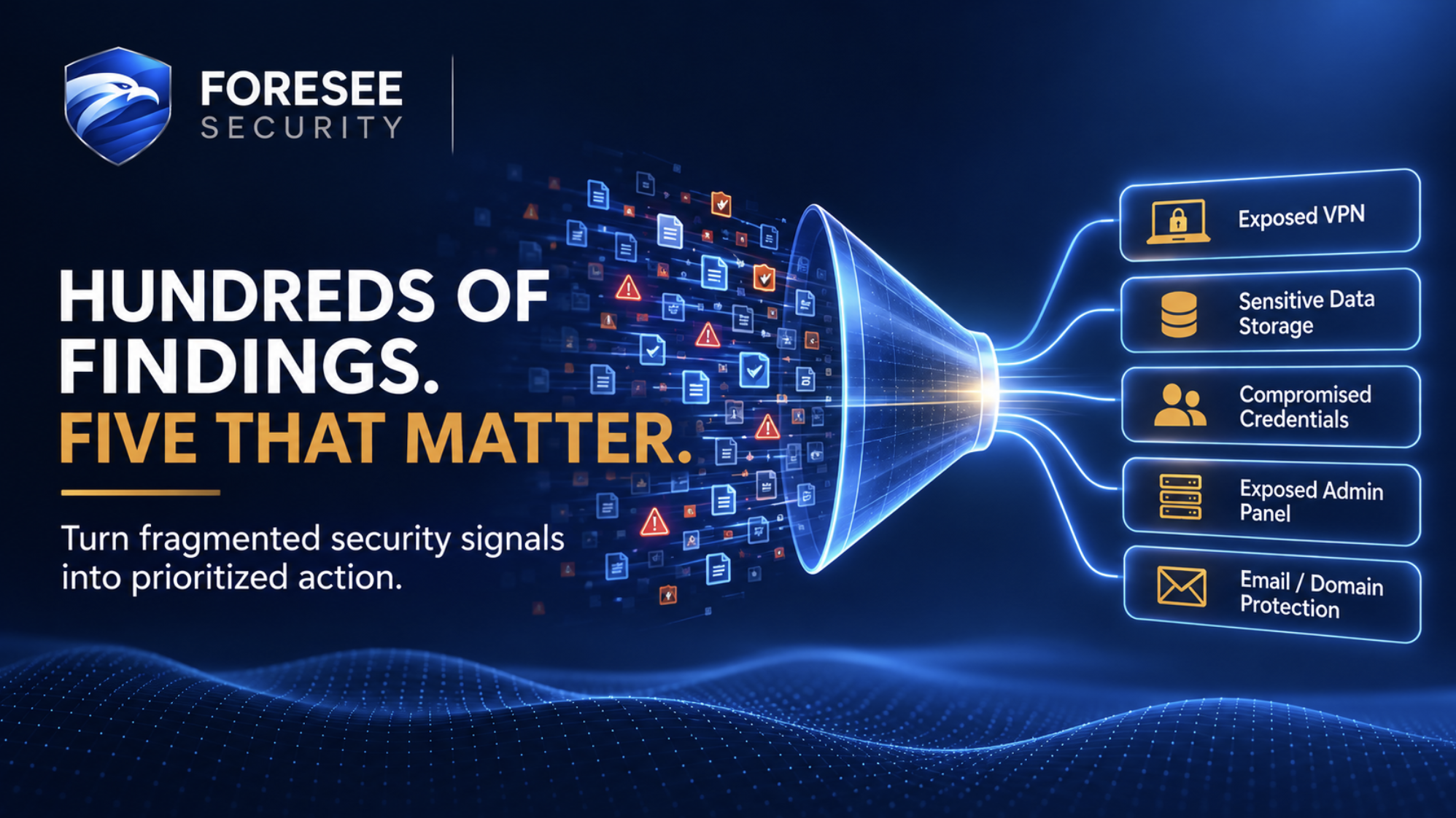
| Top issues | Expired certificates, outdated software, weak email settings | 1. Admin login on staging, no MFA. 2. Employee logins in a new breach dump. 3. Lookalike domain registered last week. 4. DMARC at "none". 5. Expired certificate on a marketing site |
| Missing | The lookalike domain and leaked logins didn't move the score | Nothing about how the company compares with peers |
| Next step | Ask the vendor what drove the drop | Fix items 1 to 3 this week |
The rating tells the board something got worse. ASM tells the team what, where and what to do first. The lookalike domain, arguably the most urgent issue, doesn't appear in the rating at all.
What is pulling your score down? Share a domain and we'll show you the exposures behind it. Book a demo.
Which one do you need?
- You need a rating if a customer contract, an insurer or the board asks for one. Keep it, and treat it as a report card.
- You need ASM if your team has to decide what to fix each week, or if you keep finding assets nobody owns.
- You need both connected if your score matters commercially. ASM is how you find and fix what is dragging the score down before the next rescan.
The mistake is paying for a rating and expecting it to run your security programme.
Picture a lender in the last stage of a partnership deal. The partner's procurement team pulls a security rating and sees a low grade. Half the findings behind it turn out to be assets the lender sold two years ago, still attributed to its name. Fixing the real issues took a week. Getting the score corrected took longer, and the deal waited.
A score is a fair first filter and a poor final answer. If a buyer is about to share data with you, the score should start the conversation, not end it.
How to use ratings and ASM together
The two work best as one loop:
- The rating flags a change. A drop in a category, or a partner asking about your score.
- ASM finds the cause. The specific assets and findings behind the drop, plus the exposures the rating can't see.
- The team fixes in order of risk, not in order of score impact.
- You keep the evidence. A dated record of what was found and fixed, useful for partners, auditors and insurers.
- The rating catches up. Ask for a rescan and dispute anything wrongly attributed.
Run this loop and the score becomes a side effect of good security, rather than a number you chase.
How to correct and improve your score
- Get the asset list the score is built on. Most vendors will share it if you ask.
- Dispute what isn't yours, with evidence such as sale documents or hosting records.
- Fix what is yours, starting with what attackers use: exposed remote access, known exploited vulnerabilities, leaked credentials and email authentication.
- Ask for a rescan once fixes are in, rather than waiting for the next cycle.
- Watch the assets the rating missed. They don't affect the score, but they affect your risk.
What to ask before you pay for a rating
- How do you decide which assets are mine, and can I see and correct that list?
- How often do you rescan after a fix?
- What does each category weigh, and why?
- Do you show the findings behind the score, or only the score?
- Can my vendors see their own findings and fix them through you?
If the answers are vague, you are paying for a number, not for insight.
Using security ratings to judge your vendors
Many companies use ratings in third-party risk management: a quick outside view of a vendor before a contract, and a signal to watch afterwards. Used well, they save time. Used alone, they mislead.
| Use ratings for | Don't use ratings for |
|---|---|
| A first filter when onboarding many vendors | The final decision on a critical vendor |
| Spotting a sudden drop that should trigger a reassessment | Proof that a vendor's internal controls work |
| Comparing a vendor's trend over time | Comparing vendors across different rating providers |
| Starting a conversation with the vendor | Replacing that conversation |
For critical vendors, ask for the findings behind the score, not just the score, and check their exposure yourself across the same areas you watch for your own company: brand, applications, network, email, public exposure and the dark web.
For how ratings fit into a full vendor risk programme, see The Third-Party Risk Management Lifecycle Explained.
Key terms
| Term | Meaning |
|---|---|
| Security rating | A score of an organisation's security built from what is visible from outside |
| Attack surface | Everything an organisation exposes that an attacker could target |
| Attack surface management (ASM) | Continuous discovery, monitoring and prioritisation of that attack surface |
| Attribution | Deciding which assets belong to which organisation |
| Outside-in | Assessed from the internet, without access to internal systems |
| Known exploited vulnerability | A flaw confirmed as being used in real attacks, such as those on CISA's KEV list |
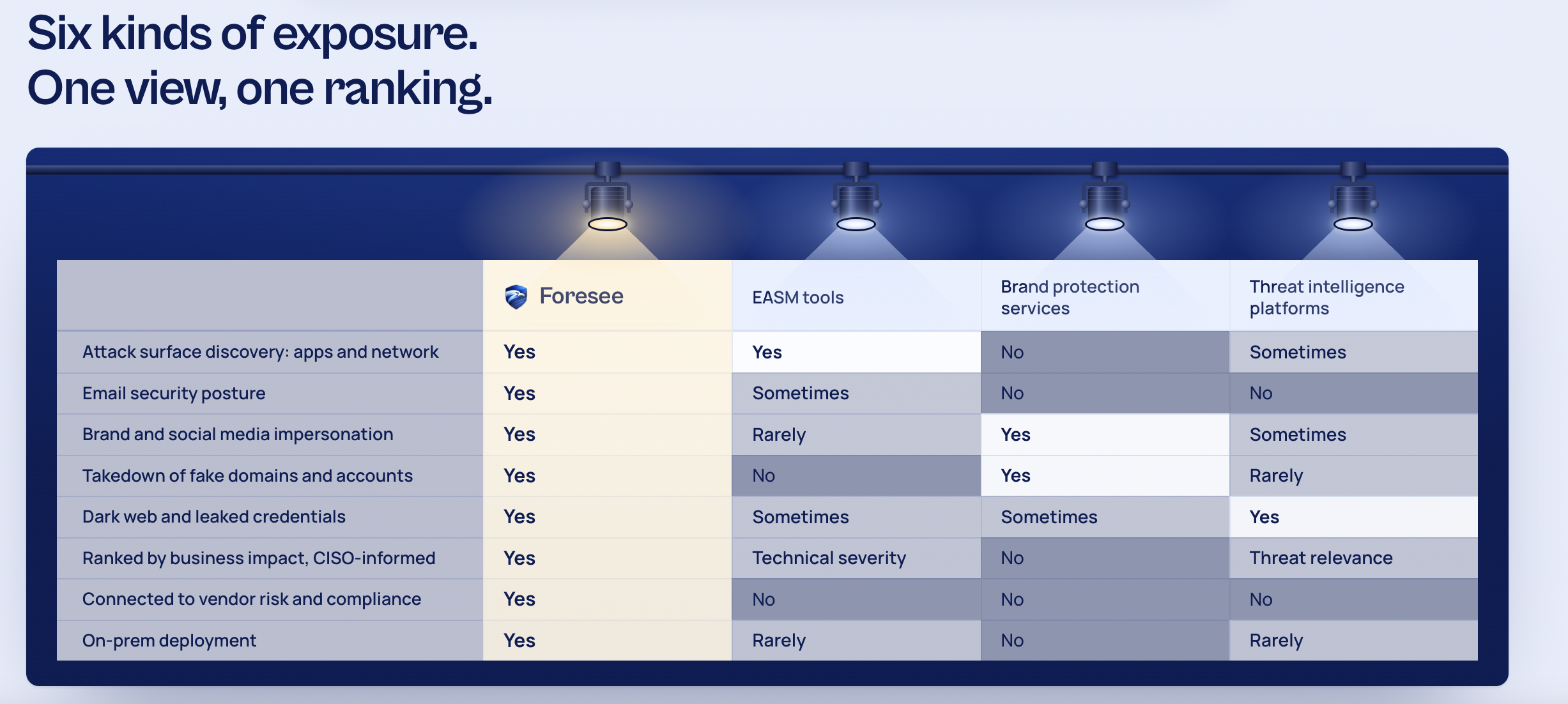
Foresee's External Exposure module shows you what rating vendors and attackers see, across brand, applications, network, email, public exposure and the dark web. Foresee AI ranks the fixes that will move both your risk and your score.
FAQs
What is a security rating? A score built from externally visible signals about an organisation's security, used by buyers, partners and insurers to compare companies quickly.
Can I improve my security rating? Yes, by fixing what the rating is built on: exposed services, unpatched systems, weak email authentication and leaked credentials. Also check that every asset counted against you actually belongs to you.
Is a security rating the same as a risk assessment? No. A rating is an outside-in snapshot. A risk assessment also weighs what each system does for the business.
Who uses security ratings? Procurement and vendor risk teams, cyber insurers, boards and partners who want a quick outside view before working with a company.
Why is my security rating lower than expected? Often because of assets wrongly attributed to you, findings already fixed but not rescanned, or one issue with an outsized weight. Ask for the asset list behind the score first.
Are security ratings accurate? They are accurate about what they observe, but they can be wrong about which assets are yours, slow to reflect fixes, and blind to controls inside your network. Treat them as a useful indicator, not a precise measurement.
What is a good security rating? Each provider uses its own scale, so there is no universal good number. Compare your trend over time and against peers in your sector on the same provider.
Does attack surface management replace a security rating? Not if partners or insurers ask for a rating. ASM replaces the guesswork behind it: it shows what is driving the score and what to fix first.
See the exposures behind your score. Book a demo or explore External Exposure.
About the author: Nikunj Mathur is Founder and CEO of Foresee Security and a practising CISO in financial services. He writes about how mid-sized companies make cyber risk decisions with small teams.
More from the blog
See all articles
4 min read
12 TPRM Metrics and KPIs to Track Program Performance
The best TPRM metrics measure exposure, not activity. "Assessments completed this quarter" tells the board your team was busy. "Critical vendors with a high-severity…
4 min read
How to Build a Third-Party Risk Management Framework
A TPRM framework is the set of rules that decides, for every third party, how much scrutiny it gets, who signs off and what happens when something goes wrong. The most…
8 min read
Your Attack Surface Never Sleeps. Why Continuous External Exposure Monitoring Is the Need of the Hour
From forgotten subdomains and exposed services to impersonating domains and leaked credentials, organisations need to know what the internet can see before attackers…

See what Foresee finds on your own domain.
A 30-minute call. Share a domain and we will walk you through what we find.